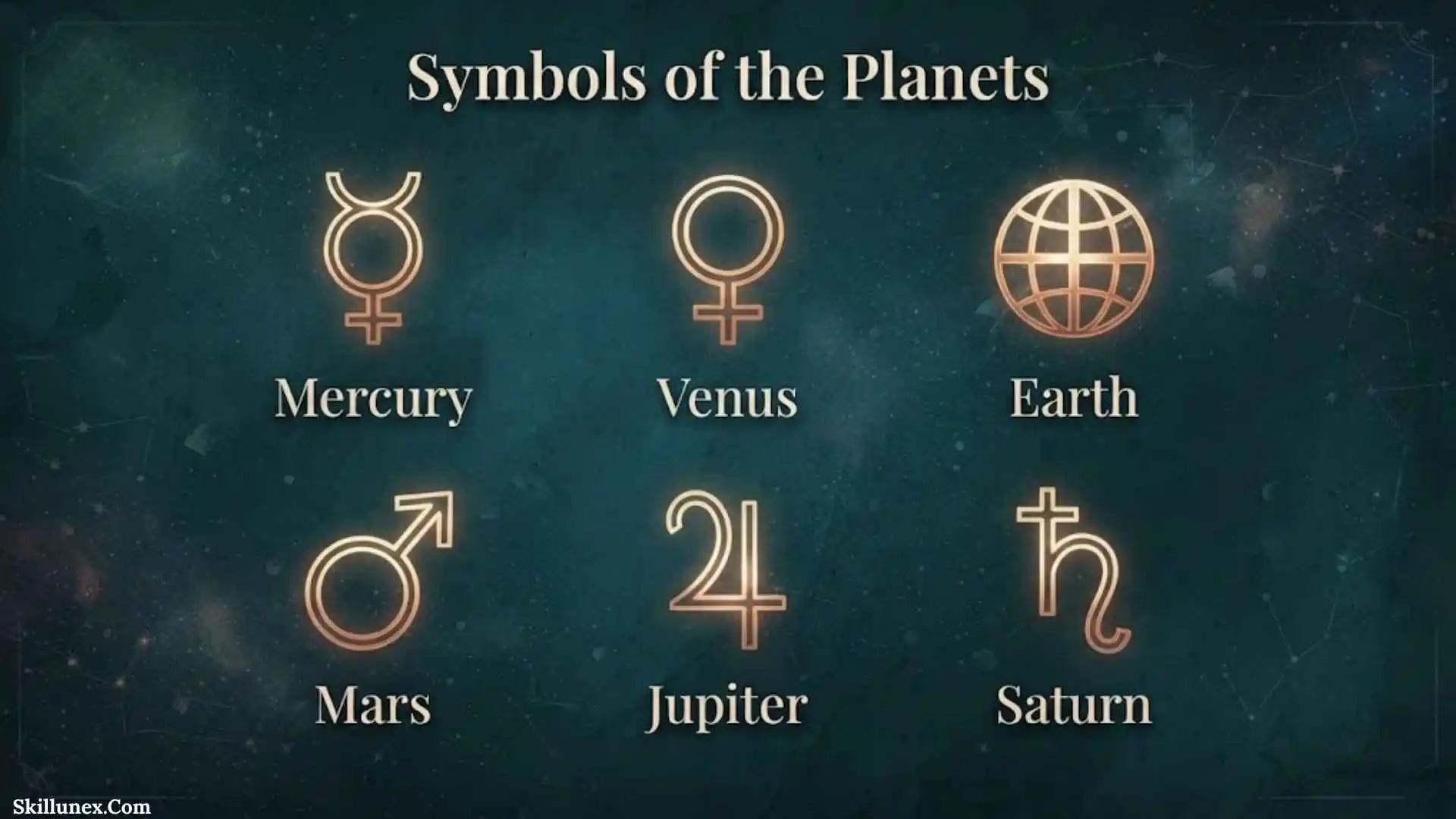
The symbols of the planets are fascinating visual signs that connect astronomy with ancient mythology, astrology, and the history of human observation of the sky. You may have seen symbols such as ☿ for Mercury, ♀ for Venus, ♂ for Mars, ♃ for Jupiter, and ♄ for Saturn without knowing where they came from or what they represent.
Each traditional planetary symbol has a distinctive history. Some are connected to the Roman and Greek gods associated with the planets, while others developed through centuries of astronomical and astrological use. In this guide, you will learn the symbols of the planets, their meanings, origins, uses, and the differences between astronomical and astrological symbolism.
What Are The Symbols Of The Planets?
Planetary symbols are graphical signs traditionally used to represent planets and other important celestial bodies. They became particularly common in astronomy and astrology before modern scientific notation became standardized.
The traditional symbols for the major planets are:
- ☿ Mercury
- ♀ Venus
- ♂ Mars
- ♃ Jupiter
- ♄ Saturn
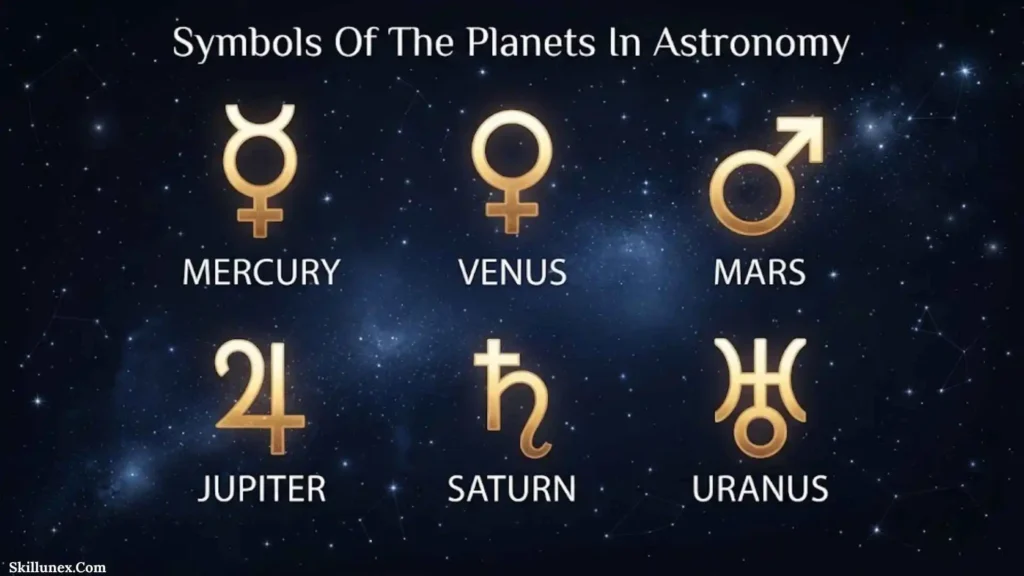
- ♅ Uranus
- ♆ Neptune
- ♇ Pluto
The Sun and Moon are not planets, but their symbols are often included in the same group because of their importance in astrology and traditional celestial symbolism.
- ☉ Sun
- ☽ Moon
Earth can also be represented by ♁, although several other Earth symbols and modern graphical representations are used.
Planet Symbols And Their Meanings
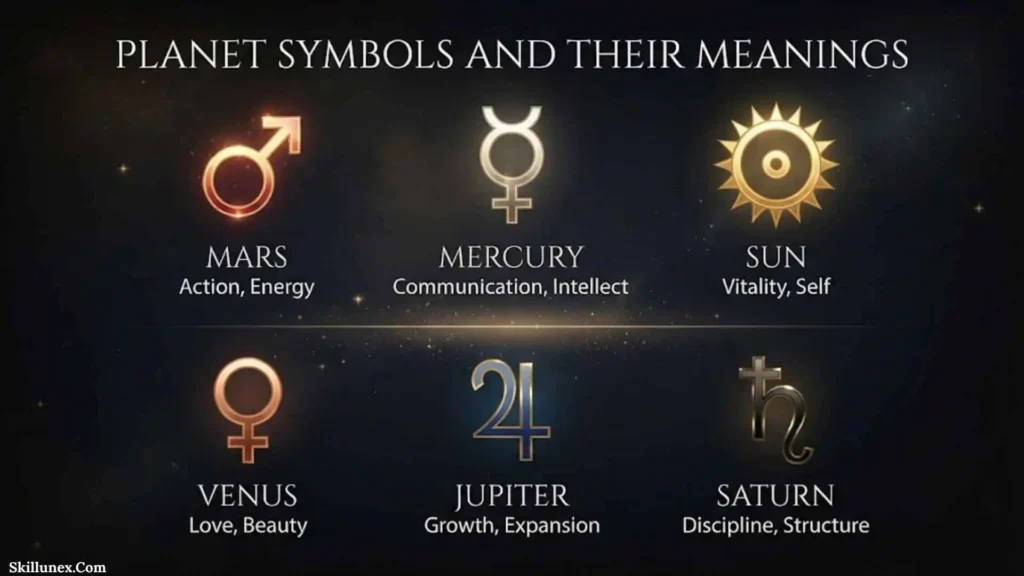
Every traditional planetary symbol has a distinctive design and cultural history. Understanding these symbols becomes easier when you look at the celestial body together with its historical and mythological associations.
Mercury Symbol ☿
The symbol ☿ represents Mercury. Its design is traditionally associated with Mercury, the Roman messenger god, and resembles elements connected with his winged imagery.
Mercury was associated with communication, travel, commerce, and messages. In astrology, Mercury is traditionally connected with communication, thought, learning, and reasoning.
The Mercury symbol is also used in historical alchemical traditions.
Venus Symbol ♀
The symbol ♀ represents Venus. It consists of a circle above a small cross and is one of the most recognizable planetary symbols.
Venus was the Roman goddess associated with love and beauty. Because of this connection, the Venus symbol has traditionally been associated with femininity, love, beauty, and relationships.
Today, ♀ is also widely recognized as the symbol for female or feminine identity, although that modern use is broader than its original planetary meaning.
Earth Symbol ♁
Earth can be represented by ♁, a symbol resembling a globe marked by a cross. It is one of several historical symbols associated with our planet.
Unlike the symbols of Mercury, Venus, Mars, Jupiter, and Saturn, Earth’s traditional symbolism developed differently because Earth was not treated as a planet in many ancient cosmological systems.
Today, the name Earth is normally used instead of a special symbol in scientific writing.
Mars Symbol ♂
The traditional symbol for Mars is ♂. It consists of a circle with an arrow pointing diagonally upward.
The symbol is associated with Mars, the Roman god of war. This connection helped give the sign associations with strength, conflict, courage, and masculine symbolism.
The same sign is also widely used as the male or masculine symbol.
Jupiter Symbol ♃
Jupiter is represented by ♃. The symbol is connected with Jupiter, the Roman counterpart of the Greek god Zeus.
Jupiter was considered the king of the gods in Roman mythology. As a result, the planetary symbol has historically been associated with authority, power, growth, and abundance in astrological traditions.
The shape of the symbol has also been interpreted in different ways throughout history.
Saturn Symbol ♄
The traditional symbol for Saturn is ♄.
Saturn was an important Roman deity associated with agriculture and time. The shape of the symbol is commonly connected with a sickle or scythe, an object associated with Saturn’s traditional imagery.
In astrology, Saturn is traditionally associated with discipline, responsibility, limits, structure, and time.
Uranus Symbol ♅
Uranus has more than one traditional symbol. The symbol ♅ is one of the most commonly recognized forms.
Unlike the classical planets, Uranus was discovered in the modern astronomical era. Consequently, its symbols developed after the traditional planetary signs had already been established.
Another symbol, ⛢, is also found in some astrological and historical contexts.
Neptune Symbol ♆
Neptune is represented by ♆, which resembles a three-pronged trident.
The design reflects Neptune, the Roman god of the sea, who is traditionally depicted carrying a trident. Because of this mythology, the Neptune symbol is particularly easy to connect with its namesake.
In astrology, Neptune is traditionally associated with imagination, dreams, intuition, spirituality, and illusion.
Pluto Symbol ♇
Pluto is commonly represented by ♇. Its design combines elements associated with the letters of Pluto’s name.
Pluto was discovered in 1930 and was historically classified as the ninth planet of the Solar System. In 2006, the International Astronomical Union classified Pluto as a dwarf planet.
The symbol ♇ remains useful when discussing Pluto in historical astronomy and astrology.
Sun And Moon Symbols
Although the Sun and Moon are not planets, they are traditionally included with planetary symbols because of their importance in astrology and ancient celestial systems.
Sun Symbol ☉
The traditional symbol for the Sun is ☉, a circle containing a central point.
The simple design visually represents the Sun as a bright celestial body. In astrology, the Sun has traditionally been associated with identity, vitality, life, and personal expression.
In astronomy, the Sun is a star rather than a planet.
Moon Symbol ☽
The Moon is traditionally represented by ☽, a crescent shape.
Different lunar symbols can represent different phases of the Moon. The crescent is particularly recognizable because the Moon’s changing appearance has been observed and recorded by human civilizations for thousands of years.
The Moon is Earth’s natural satellite, not a planet.
Planet Symbols Chart
| Celestial Body | Traditional Symbol | Type |
| Sun | ☉ | Star |
| Moon | ☽ | Natural satellite |
| Mercury | ☿ | Planet |
| Venus | ♀ | Planet |
| Earth | ♁ | Planet |
| Mars | ♂ | Planet |
| Jupiter | ♃ | Planet |
| Saturn | ♄ | Planet |
| Uranus | ♅ | Planet |
| Neptune | ♆ | Planet |
| Pluto | ♇ | Dwarf planet |
This chart provides a quick reference for recognizing the traditional symbols used for the major celestial bodies.
Inner Planet Symbols
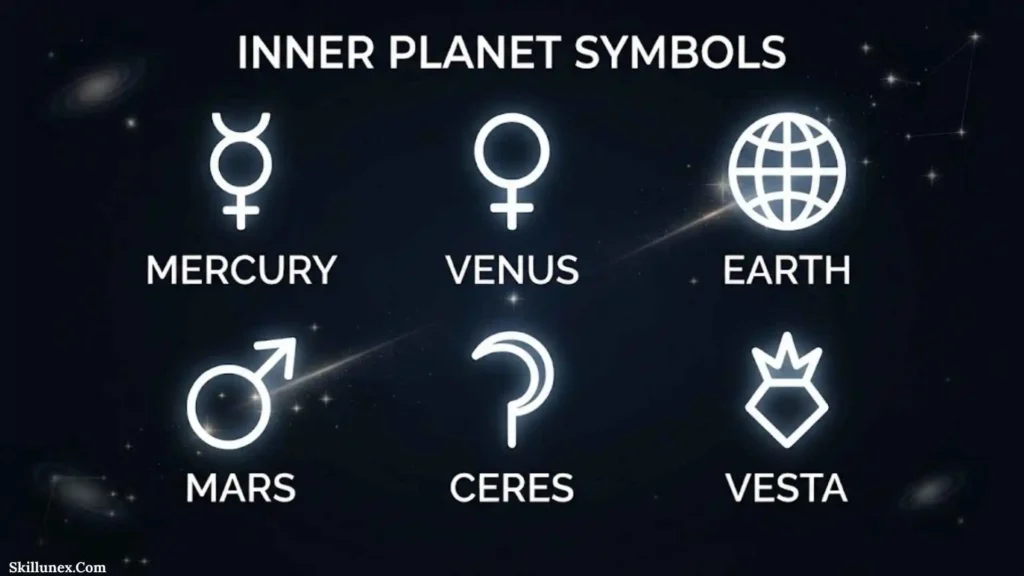
The inner planets are Mercury, Venus, Earth, and Mars. They are the four rocky planets closest to the Sun.
Mercury, Venus, Earth, And Mars
Mercury ☿ is the smallest major planet and the closest planet to the Sun. Its symbol is traditionally connected with the Roman messenger god Mercury.
Venus ♀ is the second planet from the Sun. Its symbol is associated with the Roman goddess Venus and is also used as a feminine symbol.
Earth ♁ is the planet on which we live. Its traditional symbol represents the globe, although its use is much less common in modern scientific writing.
Mars ♂ is the fourth planet from the Sun. Its symbol reflects its connection with the Roman god of war and is also used as a masculine symbol.
Outer Planet Symbols
The outer planets are Jupiter, Saturn, Uranus, and Neptune. They are located farther from the Sun than the inner planets.
Jupiter, Saturn, Uranus, And Neptune
Jupiter ♃ is the largest planet in the Solar System, and its traditional symbol is connected with the Roman king of the gods.
Saturn ♄ is famous for its prominent ring system. Its symbol is traditionally associated with the Roman god Saturn and his agricultural imagery.
Uranus ♅ is an ice giant discovered in the modern era. Its symbols were developed later than those of the classical planets.
Neptune ♆ is the outermost recognized major planet in the Solar System. Its trident-shaped symbol reflects its connection with the Roman god of the sea.
Symbols Of The Planets In Astrology
Planetary symbols are especially important in astrology. Birth charts and other astrological charts use compact symbols to identify planets and other celestial points.
For example, you may see ☿ for Mercury, ♀ for Venus, ♂ for Mars, ♃ for Jupiter, and ♄ for Saturn. The Sun and Moon are also represented by ☉ and ☽.
Astrological traditions assign symbolic meanings to these celestial bodies. These interpretations are part of astrology rather than scientific descriptions of physical planetary effects.
Symbols Of The Planets In Astronomy
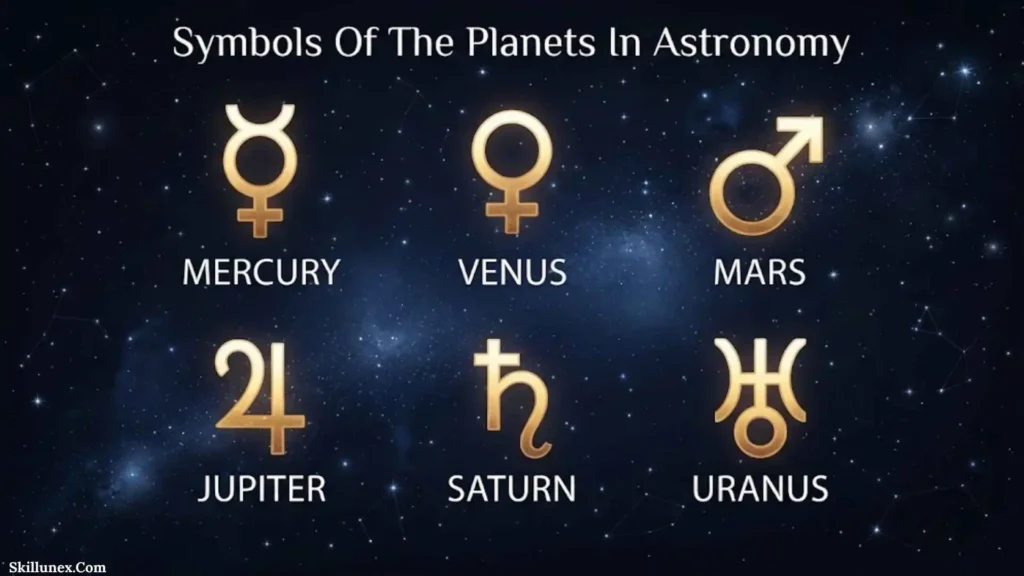
Modern astronomy generally uses planet names rather than traditional planetary symbols in scientific research and technical communication.
For example, astronomers normally write Mercury, Venus, or Jupiter rather than relying on ☿, ♀, or ♃. This makes scientific writing more standardized and easier to interpret across different contexts.
However, planetary symbols remain useful in educational materials, historical documents, astronomical artwork, calendars, diagrams, and discussions about the history of astronomy.
Ancient Origins Of Planetary Symbols
The history of planetary symbols is connected with humanity’s long-standing interest in the night sky. Ancient civilizations observed the movements of bright celestial bodies and developed systems for identifying and interpreting them.
The Greeks and Romans connected several visible planets with their gods. The Romans eventually gave the planets names associated with deities such as Mercury, Venus, Mars, Jupiter, and Saturn.
Later astronomical and astrological traditions developed graphical signs for these celestial bodies. The symbols changed and evolved over time, eventually becoming recognizable forms used in Western astrology and historical astronomy.
Why Do Planet Symbols Look Different From Their Names?
Planetary symbols were not designed simply by taking the first letter of each planet’s English name.
Many traditional symbols developed from mythology, ancient astronomical practices, planetary deities, and historical writing systems. This is why Mercury is ☿ rather than M, and Jupiter is ♃ rather than J.
The symbols therefore preserve part of the cultural history surrounding the planets.
Planet Symbols And Roman Gods
The traditional names of several planets come from Roman gods, and this mythology is closely connected with their symbols.
- Mercury ☿ — associated with the Roman messenger god Mercury
- Venus ♀ — associated with Venus, goddess of love and beauty
- Mars ♂ — associated with Mars, god of war
- Jupiter ♃ — associated with Jupiter, king of the gods
- Saturn ♄ — associated with Saturn, deity connected with agriculture and time
- Neptune ♆ — associated with Neptune, god of the sea
- Uranus ♅ — named after the ancient Greek deity Uranus
- Pluto ♇ — named after Pluto, the Roman god associated with the underworld
These associations explain why mythology plays such an important role in understanding traditional planetary symbols.
Planet Symbols In Alchemy
Planetary symbols also appeared in historical alchemy. Alchemists traditionally associated certain metals with celestial bodies and used planetary signs to represent them.
For example, historical traditions connected:
- ☉ Sun with gold
- ☽ Moon with silver
- ☿ Mercury with mercury
- ♀ Venus with copper
- ♂ Mars with iron
- ♃ Jupiter with tin
- ♄ Saturn with lead
These associations belong to the history of alchemy and should not be confused with modern chemistry.
Why Are Planet Symbols Still Used Today?
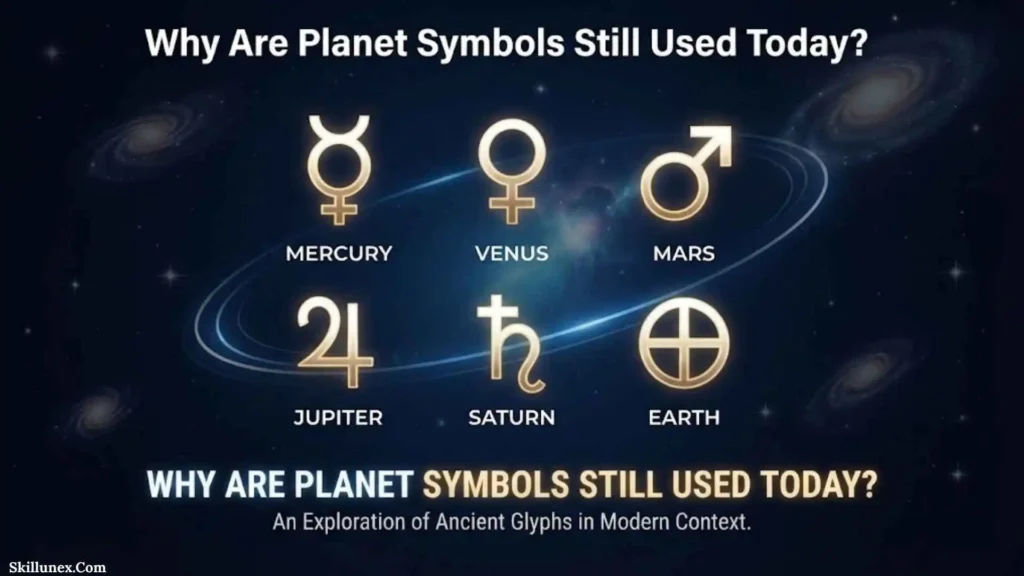
Planetary symbols remain popular because they are visually distinctive and easy to recognize. You may encounter them in astrology charts, educational resources, historical books, tattoos, artwork, jewelry designs, calendars, and symbolism guides.
They also provide a connection to the history of astronomy. Even though scientists rarely depend on these symbols in modern technical research, the signs remain a useful part of the cultural history of astronomy and astrology.
Frequently Asked Questions About Symbols Of The Planets
What Is The Symbol For Mercury?
The traditional symbol for Mercury is ☿. It is associated with the Roman god Mercury and is commonly used in astrology and historical astronomical symbolism.
What Is The Symbol For Venus?
The symbol for Venus is ♀. It traditionally represents the planet Venus and is also widely used as a symbol associated with female or feminine identity.
What Is The Symbol For Mars?
Mars is represented by ♂. The symbol consists of a circle with an arrow and is traditionally associated with the Roman god of war.
What Is The Symbol For Jupiter?
The traditional symbol for Jupiter is ♃. It is associated with Jupiter, the Roman king of the gods.
What Is The Symbol For Saturn?
Saturn is represented by ♄. Its traditional design is associated with Saturn’s mythological imagery and the sickle or scythe.
What Is The Symbol For Uranus?
One widely recognized symbol for Uranus is ♅. Another historical form is ⛢. Both can be encountered in astrological and historical contexts.
What Is The Symbol For Neptune?
Neptune is represented by ♆. Its trident-like shape reflects Neptune’s traditional association with the Roman god of the sea.
What Is The Symbol For Pluto?
Pluto is commonly represented by ♇. Although Pluto is classified as a dwarf planet rather than a planet, its traditional symbol continues to be used.
Are The Sun And Moon Planet Symbols?
The Sun and Moon are not planets, but they are often included in lists of planetary symbols because they have traditionally been important in astrology and celestial symbolism. Their common symbols are ☉ and ☽.
Are Planetary Symbols Used In Modern Astronomy?
Planetary symbols are still recognized, but modern astronomers generally use the written names of planets in scientific publications and technical communication. The symbols are more common in historical, educational, artistic, and astrological contexts.
Conclusion
The symbols of the planets are more than simple decorative signs. They preserve connections between celestial observation, mythology, astrology, alchemy, and the history of astronomy. From Mercury’s ☿ to Neptune’s ♆, each traditional symbol has its own distinctive design and historical background.
Learning these symbols makes it easier for you to recognize planets in charts, historical texts, educational materials, and astrological diagrams. Whether you are exploring astronomy, mythology, or the history of celestial symbolism, these signs offer a fascinating way to see how humans have represented the planets for centuries.

Isla Kensington
I’m Isla Kensington, a writer with a passion for research, culture, nature, and the fascinating meanings behind everyday things. I enjoy taking topics that may seem simple at first and discovering the history, facts, and ideas that make them more interesting.
I write with readers in mind. My aim is to provide clear explanations, useful information, and interesting details without making a topic unnecessarily complicated.
I believe learning should feel like discovering something rather than simply reading facts. That philosophy guides the content I create and the topics I choose to explore.
## Books by Isla Kensington
* Symbols Around the World: A Guide to Meaning & Culture
* Nature’s Beautiful Places: Lakes, Landscapes & Natural Treasures