Change is a natural part of life, and I believe we all experience it in different ways. Sometimes you choose change because you want a fresh start, while other times it arrives unexpectedly and pushes you into a new chapter. That’s why symbols that represent change can feel so meaningful when words aren’t enough to describe what you’re going through.
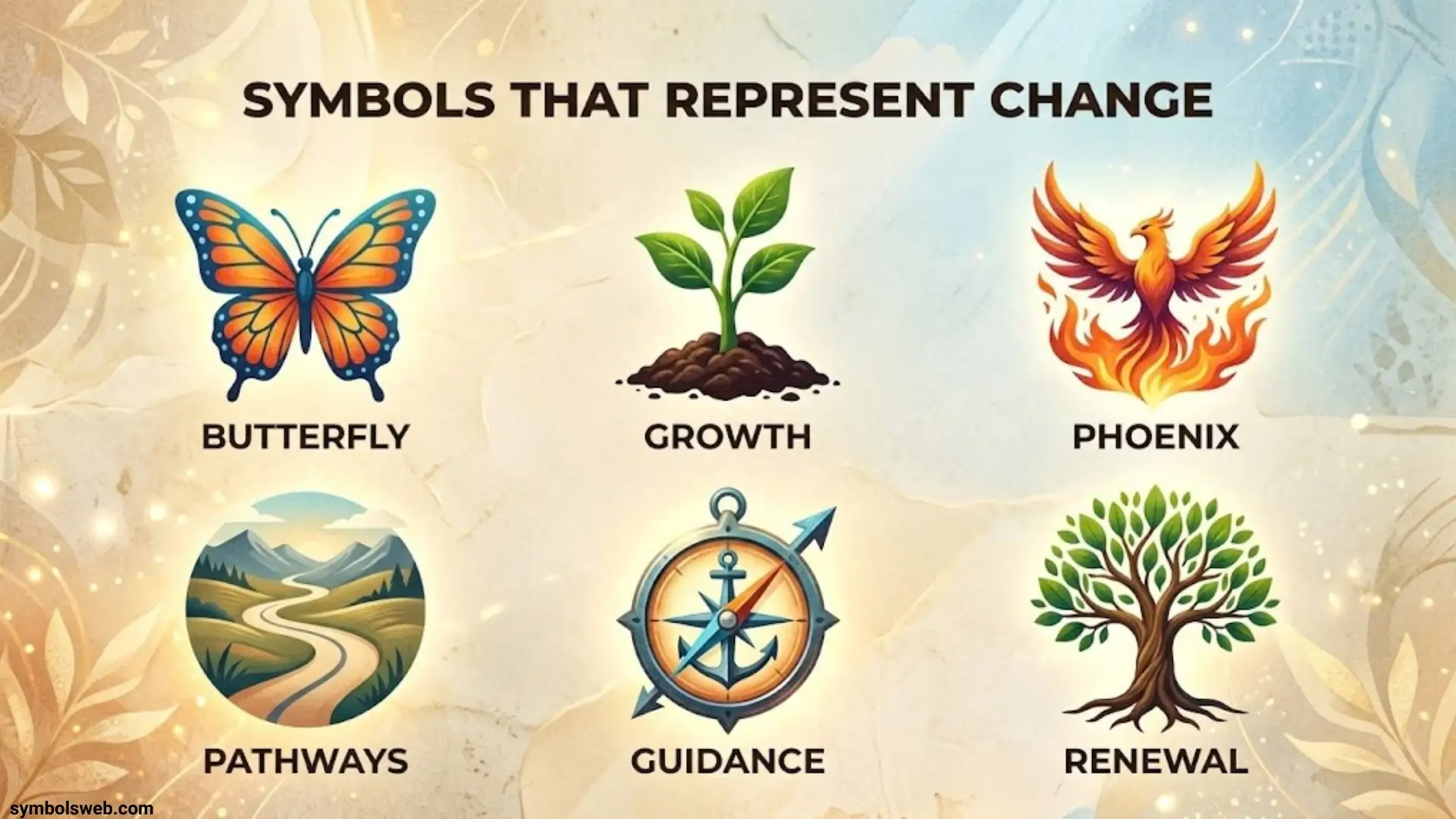
When I look at symbols of change, I see more than simple shapes, objects, or images. A butterfly can remind you of transformation, a phoenix can represent rebirth, and a winding path can reflect the journey from one stage of life to another. These symbols can help you express personal growth, new beginnings, healing, transformation, and the courage to move forward.
If you’re looking for a symbol that represents a change in your own life, I want you to think about what that change means to you. You might want a meaningful tattoo, artwork, jewelry design, social media symbol, or simply an image that reflects your journey. In this guide, I’ll explore powerful symbols that represent change and explain the meanings behind them so you can find one that truly connects with you.
Symbols That Represent Change: (Quick Answer)
Symbols that represent change are images, objects, animals, natural events, and patterns associated with transformation, growth, renewal, transition, or new beginnings. Common examples include the butterfly, phoenix, snake, ouroboros, lotus, moon, spiral, sunrise, seasons, tree, and yin-yang. Their meanings vary across cultures and personal experiences.
Quick Facts About Symbols That Represent Change
| Aspect | Information |
| Origin | Found across nature, mythology, religion, philosophy, art, and cultural traditions |
| Historical Significance | Humans have used symbolic images to explain cycles of life, death, rebirth, growth, and transition |
| Main Meaning | Transformation, renewal, growth, adaptation, endings, and new beginnings |
| Spiritual Meaning | Awakening, rebirth, release, inner growth, and movement from one state of being to another |
| Cultural Importance | Different societies attach unique meanings to animals, plants, celestial bodies, and mythological figures |
| Modern Usage | Tattoos, jewelry, fashion, artwork, branding, home decor, social media, and personal rituals |
What Are Symbols That Represent Change?
Symbols that represent change are visual or conceptual signs that help people express the idea of moving from one state to another.
Change can be physical, emotional, social, spiritual, or psychological. A person may change careers, recover from hardship, fall in love, lose someone, move to another country, mature with age, or discover a new sense of identity.
Because change can feel uncertain, humans often give it a visible form.
A butterfly makes transformation easy to imagine. A falling leaf can represent letting go. A sunrise can suggest a fresh beginning. A circle can represent a cycle that continues even when one stage ends.
This is why symbols of change appear in so many places, from ancient tombs and religious artwork to modern tattoos and social media posts.
Why Did Humans Create Symbols of Change?
One reason is that change is difficult to see directly.
You can see a tree grow, but you cannot see “personal growth” in the same way. You can see the seasons move from winter to spring, but you cannot physically see hope returning after a difficult period.
Symbols bridge that gap.
They turn an invisible experience into something we can see, remember, wear, draw, or share.
Ancient Egyptian culture provides a powerful example. The lotus was associated with rebirth and renewal because the flower opened during the day and closed at night. The scarab was also connected with renewal and the rising sun.
These were not simply decorative images. They were connected to larger ideas about life, death, regeneration, and the order of the universe.
Change Is Not Always the Same as Transformation
The words “change” and “transformation” are often used as if they mean exactly the same thing.
They do not.
Change can be small or temporary. Transformation usually suggests a deeper shift in identity or condition.
For example:
- A new hairstyle is a change.
- Learning a new skill is growth.
- Leaving an unhealthy relationship may be transformation.
- Recovering after a major loss can become a profound personal transformation.
- A butterfly’s metamorphosis is a natural example of dramatic transformation.
This difference matters when choosing a symbol.
If you want to represent adaptation, a flowing river may be more appropriate than a phoenix. If you want to represent rebirth after hardship, the phoenix may feel more powerful.
Deep Symbolic Meaning of Symbols That Represent Change
Spiritual Meaning
On a spiritual level, symbols of change often represent the movement from an old state of consciousness into a new one.
This can mean awakening, purification, renewal, surrender, rebirth, or a deeper understanding of life.
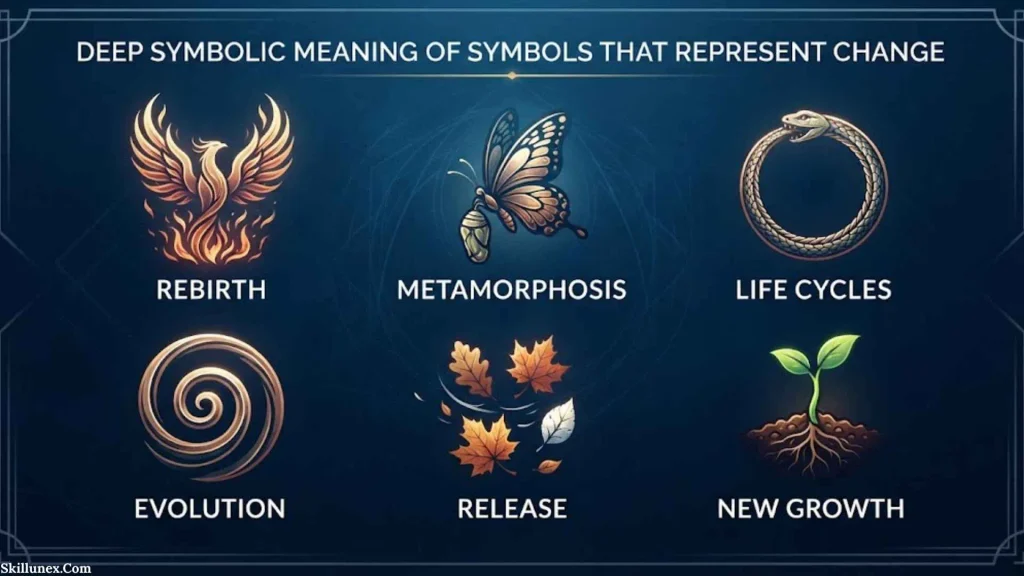
The butterfly can represent the soul emerging from an old form. The lotus can represent spiritual growth through difficulty. The phoenix can represent rising after destruction.
The important point is that spiritual symbolism is interpretive. A symbol does not carry one universal spiritual message for everyone.
Instead, people bring their beliefs, experiences, and traditions to the image.
Psychological Meaning
Psychologically, symbols help people give meaning to experiences that may otherwise feel confusing.
Carl Jung’s analytical psychology placed strong importance on symbols, myths, dreams, and archetypal images. From a Jungian perspective, images of death, rebirth, journeys, shadows, water, animals, and transformation can become ways of expressing inner psychological processes.
A butterfly appearing in a dream, for example, does not automatically mean “you are going to change.”
It may represent freedom, vulnerability, beauty, identity, memory, or transformation depending on the dreamer’s personal associations.
The same principle applies to a phoenix.
For one person, it may represent recovery after grief. For another, it may represent starting over after failure.
Cultural Meaning
Symbols also carry cultural memory.
A symbol may mean one thing in one society and something very different somewhere else.
The snake is a perfect example.
Its ability to shed its skin can suggest renewal and regeneration. Yet in some religious and cultural contexts, snakes may also represent danger, temptation, chaos, healing, wisdom, fertility, or hidden knowledge.
Therefore, there is rarely a simple dictionary definition for a symbol.
Context matters.
Types and Variations of Symbols That Represent Change
Butterfly
Visual description: A winged insect that develops through egg, caterpillar, chrysalis, and adult stages.
Meaning: Transformation, freedom, growth, rebirth, beauty, and personal change.
Symbolism: The butterfly is perhaps the clearest natural image of metamorphosis. It begins life in a completely different form and eventually emerges with wings.
Cultural connection: In ancient Greek thought, psyche could mean both “soul” and “butterfly,” and the mythological figure Psyche became closely associated with butterfly imagery.
Where it appears: Tattoos, jewelry, poetry, paintings, memorial art, dreams, spiritual writing, and fashion.
Phoenix
Visual description: A mythical bird associated with fire and rebirth.
Meaning: Rebirth, resilience, renewal, survival, and rising after destruction.
Symbolism: The phoenix expresses one of the strongest forms of change: becoming new after an ending.
The ancient Egyptian Bennu bird is historically important to the development of phoenix traditions, but it should not simply be treated as identical to the later Greek phoenix. The traditions influenced one another while remaining culturally distinct.
Where it appears: Mythology, literature, heraldry, religious symbolism, fantasy stories, tattoos, films, and popular culture.
Snake or Serpent
Visual description: A snake, often shown shedding its skin.
Meaning: Renewal, regeneration, healing, transformation, danger, wisdom, or rebirth.
Symbolism: A snake appears to become new when it leaves its old skin behind. This makes it a natural image for releasing an old identity.
Where it appears: Egyptian art, Greek mythology, Indian traditions, African traditions, mythology, medicine, tattoos, jewelry, and modern spiritual art.
Ouroboros
Visual description: A serpent or dragon forming a circle by biting its own tail.
Meaning: Cycles, eternity, renewal, self-renewal, life and death, and continuity.
Symbolism: Unlike the butterfly, which represents transformation from one form into another, the ouroboros emphasizes cyclical change.
The ending becomes part of the beginning.
The symbol became especially important in later Western esoteric, Gnostic, Hermetic, and alchemical traditions.
Lotus Flower
Visual description: A flower rising above water and opening toward the light.
Meaning: Rebirth, spiritual growth, purity, renewal, resilience, and awakening.
Symbolism: The lotus is especially powerful because it grows in muddy environments yet produces a striking flower above the water.
Ancient Egyptian art associated the lotus with rebirth and renewal. Lotus symbolism also became deeply important in Hindu and Buddhist traditions, where it can represent spiritual development and awakening.
Yin Yang
Visual description: A circular black-and-white symbol containing a small portion of the opposite color within each side.
Meaning: Balance, interdependence, cycles, complementary forces, and continuous change.
Symbolism: Yin and yang are not simply “good versus evil.” In Chinese philosophical traditions, they describe complementary forces that interact and transform into one another.
The image therefore represents change as a process of movement and balance rather than a simple battle between opposites.
Moon Phases
Visual description: The changing appearance of the moon from new moon to full moon and back again.
Meaning: Cycles, renewal, time, emotional change, endings, and beginnings.
Symbolism: The moon seems to disappear and return repeatedly. This makes it a powerful metaphor for periods when life feels empty before something new emerges.
Spiral
Visual description: A curved line that circles outward or inward.
Meaning: Growth, evolution, development, movement, and ongoing transformation.
Symbolism: A spiral suggests that change can be circular without being repetitive. We may return to familiar issues, but we often meet them as a different person.
Sunrise
Visual description: The sun appearing above the horizon.
Meaning: Hope, new beginnings, renewal, clarity, and fresh opportunities.
Symbolism: A sunrise is one of the simplest symbols of starting again.
It also carries a powerful emotional message: darkness does not last forever.
Seasons
Visual description: Spring, summer, autumn, and winter.
Meaning: Life cycles, growth, maturity, decline, rest, and renewal.
Symbolism: The seasons show that change is not necessarily a problem to solve. Sometimes change is simply part of being alive.
Tree
Visual description: A rooted tree with branches reaching upward.
Meaning: Growth, resilience, continuity, family, evolution, and connection.
Symbolism: Trees change constantly while remaining rooted in the same place.
That makes the tree an excellent symbol for people who want to represent personal growth without forgetting their origins.
Falling Leaf
Visual description: A leaf separating from a tree.
Meaning: Letting go, acceptance, transition, aging, and release.
Symbolism: The falling leaf reminds us that not every ending is a failure.
Sometimes growth requires releasing what once helped us survive.
Egg
Visual description: An enclosed shell containing developing life.
Meaning: Potential, birth, beginnings, creation, and hidden transformation.
Symbolism: The egg represents change that has not yet become visible.
It is especially meaningful when someone is beginning a new chapter but has not yet seen the final result.
Koi Fish
Visual description: A colorful carp swimming against or through flowing water.
Meaning: Perseverance, courage, determination, growth, and transformation.
Symbolism: East Asian stories about koi reaching the Dragon Gate and becoming dragons have helped make the fish a modern symbol of perseverance and transformation.
Koru
Visual description: A spiral inspired by the unfurling young frond of a fern.
Meaning: New life, growth, movement, continuity, and returning to one’s origins.
Cultural connection: The koru is an important Māori artistic motif. Its spiral form can express the idea that life changes while remaining connected to its origins.
It is important to recognize that Māori symbolism belongs to a living culture and should not be reduced to a generic “tribal” design.
Hourglass
Visual description: Two glass chambers connected by a narrow passage through which sand falls.
Meaning: Time, transition, mortality, change, and the temporary nature of life.
Symbolism: The hourglass reminds us that change is inseparable from time.
Crossroads
Visual description: A point where different roads meet.
Meaning: Choice, transition, uncertainty, opportunity, and a new direction.
Symbolism: Unlike the butterfly or phoenix, the crossroads focuses on the human decision involved in change.
Open Door
Visual description: A doorway leading into another space.
Meaning: Opportunity, transition, possibility, and entering a new stage of life.
Symbolism: The door is especially common in modern psychological and literary symbolism because it represents a boundary between what is known and what comes next.
Symbols That Represent Change Across Different Cultures
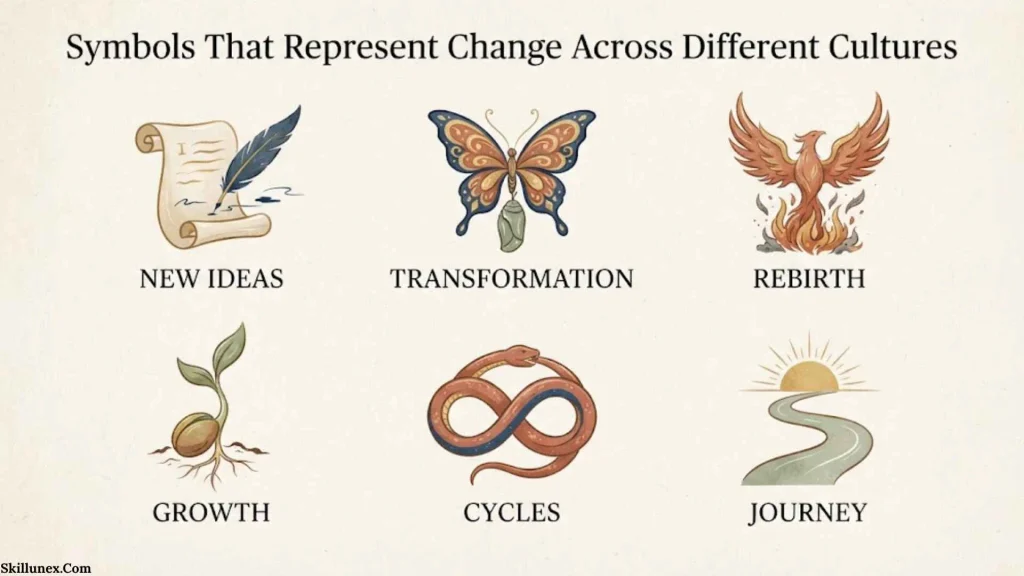
Ancient Egypt
Ancient Egyptian symbolism provides some of the strongest historical examples of renewal and rebirth.
The scarab was connected with Khepri, a deity associated with the rising sun, transformation, and rebirth. The movement of the beetle and the emergence of young beetles contributed to its symbolic associations with renewal.
The lotus was another important image. Its daily opening and closing became associated with rebirth and renewal.
The Bennu bird also deserves attention. Egyptian religious traditions connected it with creation and renewal. Greek writers later associated Egyptian imagery with the phoenix.
Egyptian symbolism shows that change was not viewed only as personal development. It could also describe the renewal of the sun, the natural world, kingship, and existence after death.
Ancient Greece
Greek mythology gave transformation symbolism an especially rich language.
The story of Psyche is one of the clearest examples. Psyche’s name is associated with both the soul and butterfly imagery, and later artistic traditions frequently represented her with butterfly wings.
Greek mythology also contains stories of dramatic transformation involving gods, humans, animals, plants, and landscapes.
For the Greeks, transformation could be a reward, punishment, escape, tragedy, or divine intervention.
This is an important reminder that change is not always positive.
Sometimes transformation comes with loss.
Roman Culture
Roman culture inherited and adapted many Greek mythological themes while developing its own symbolic traditions.
Janus, the Roman god associated with doors, transitions, beginnings, and thresholds, is especially relevant to the symbolism of change.
Janus was traditionally depicted with two faces, one looking forward and another looking backward.
The image captures something deeply human.
Whenever we enter a new stage of life, we often look toward the future while remembering where we came from.
The modern name of January preserves this association with beginnings and transition.
Eastern Traditions
Eastern traditions offer many different ways of understanding change.
In Chinese philosophy, yin and yang describe complementary forces that continually interact and shift. Change is therefore not simply an interruption of stability. It is part of the natural order.
In Buddhism, the idea of impermanence is central. Everything has changed. This does not necessarily mean that change should be feared. Instead, recognizing impermanence can become part of understanding suffering, attachment, and liberation.
The lotus became a powerful Buddhist symbol because it can represent spiritual development and awakening.
In Hindu traditions, lotus imagery also carries deep religious significance, appearing in associations with deities, creation, purity, and spiritual realization.
These traditions should not be collapsed into one generic idea of “Eastern spirituality.” Each has its own history, texts, practices, and interpretations.
Indigenous Traditions
Indigenous cultures around the world have developed their own rich symbolic systems, and there is no single Indigenous meaning of change.
For example, Māori traditions use the koru, based on an unfurling fern frond, as a significant artistic motif associated with creation, growth, and the relationship between movement and continuity.
In some Indigenous American and Amazonian traditions, animal life cycles can also become part of understanding of transition and relationships between living beings.
The Smithsonian’s National Museum of theIndigenous peoples of America has documented how butterfly and other animal transformations can appear within Indigenous ceremonial contexts.
The safest approach is to study each tradition on its own terms rather than combining unrelated cultures into one symbolic category.
Modern Interpretations
Modern society has created its own symbols of change.
A butterfly tattoo may represent recovery. A phoenix may represent surviving trauma or rebuilding after failure. A broken chain may represent freedom. A sunrise may represent a new chapter.
The meaning is often intensely personal.
A symbol that had one meaning thousands of years ago can acquire a new meaning in contemporary life without completely losing its historical roots.
Similar Symbols and Their Meanings
| Symbol | Main Meaning | Type of Change |
| Butterfly | Metamorphosis | Becoming something new |
| Phoenix | Rebirth | Starting again after destruction |
| Snake | Renewal | Shedding the old |
| Ouroboros | Cycles | Repeating renewal |
| Lotus | Spiritual growth | Rising through difficulty |
| Yin-yang | Balance | Change through interaction |
| Moon | Cycles | Gradual transformation |
| Spiral | Development | Ongoing growth |
| Sunrise | New beginning | Starting again |
| Tree | Growth | Long-term development |
| Falling leaf | Release | Letting go |
| Koru | New life | Growth with continuity |
| Crossroads | Choice | Changing direction |
| Hourglass | Time | Inevitable transition |
Butterfly vs. Phoenix
The butterfly represents transformation through metamorphosis.
The phoenix represents rebirth through destruction and renewal.
If your story is about becoming a different version of yourself, the butterfly may fit better.
If your story is about surviving something that almost destroyed you, the phoenix may feel more appropriate.
Lotus vs. Butterfly
Both can symbolize transformation, but their emotional tone differs.
The butterfly emphasizes visible metamorphosis.
The lotus emphasizes growth through difficult conditions and spiritual awakening.
Ouroboros vs. Yin-Yang
Both can represent cycles, but they do so differently.
The ouroboros focuses on continuity and the cycle of ending and beginning.
Yin-yang focuses on the relationship and dynamic balance between complementary forces.
Common Misconception: There Is One Universal Symbol for Change
There is no single symbol that universally means “change.”
The butterfly may be widely recognized as a transformation symbol, but meanings depend on history and context.
A symbol can also carry several meanings at once.
That is what makes symbolism powerful.
Symbols of Change in Mythology and Folklore
The Phoenix and the Story of Rebirth
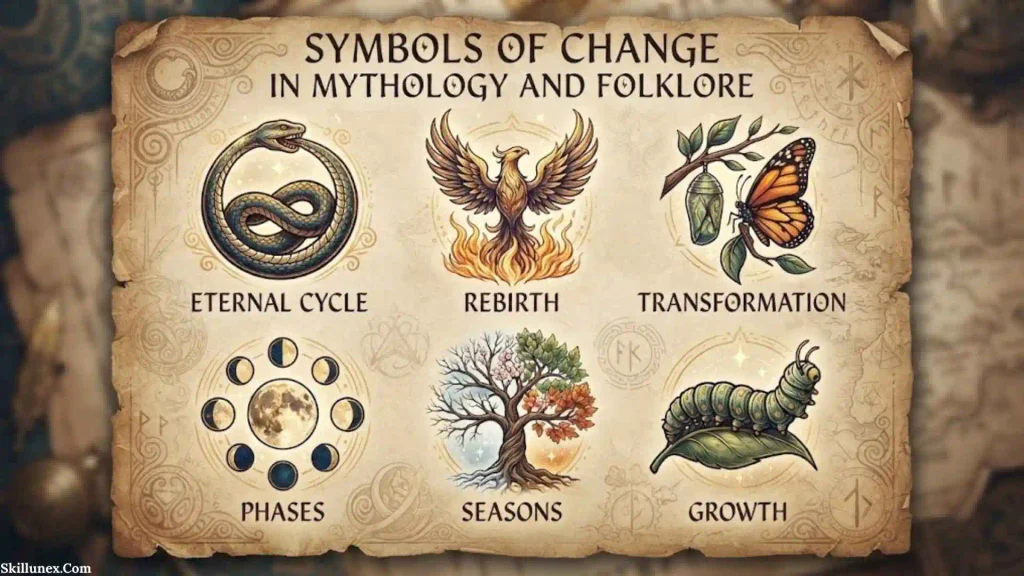
Few images express renewal as dramatically as the phoenix.
In later Greek and European traditions, the phoenix became associated with a bird that renews itself through fire.
The idea became especially powerful because destruction and creation are placed in the same story.
The fire that destroys the old phoenix becomes part of the process that produces the new one.
This is why the phoenix remains popular whenever people talk about resilience.
Psyche and the Butterfly
The myth of Psyche became an important source for butterfly symbolism in Western art.
Psyche undergoes trials, loss, separation, and transformation before reaching a new state of existence.
Later artists frequently represented her with butterfly wings.
The butterfly therefore became more than an insect. It became an image of the soul.
The Ouroboros and the Eternal Cycle
The ouroboros shows a serpent consuming its own tail.
It creates a closed circle with no obvious beginning or end.
In later esoteric and alchemical traditions, this became associated with eternity, unity, cyclical time, self-renewal, and the relationship between opposites.
Its message is different from “change means becoming something completely different.”
Instead, it suggests that change can occur within a continuing cycle.
The Koi and the Dragon Gate
In Chinese folklore, the koi that succeeds in reaching the Dragon Gate can become a dragon.
The story became a powerful metaphor for perseverance.
The transformation is not effortless.
The fish must struggle upstream.
That makes the koi especially meaningful for people who see change as something earned through persistence.
Symbols of Change in Art, Literature, Movies and Pop Culture
Symbols of change have always been useful to artists because they allow a complicated emotional idea to become instantly recognizable.
Paintings and Visual Art
Artists have used butterflies, flowers, birds, snakes, trees, moons, doors, mirrors, and changing landscapes to represent mortality, rebirth, identity, desire, and transformation.
The butterfly became especially important in European representations of Psyche.
The phoenix has also appeared in royal imagery, religious art, literature, heraldry, and decorative design.
Modern artists continue to use these symbols because viewers understand their emotional associations quickly.
Literature
Writers often use symbolic transformation to show character development.
A character may enter a forest and emerge changed. A door may represent a decision. Winter may represent emotional isolation. Spring may suggest recovery.
Franz Kafka’s The Metamorphosis uses physical transformation to explore alienation, identity, family, and the human condition.
Fantasy literature often uses phoenixes, magical rebirth, enchanted forests, dragons, and shape-shifting to turn inner change into visible storytelling.
Movies and Television
Film uses visual symbolism especially well.
A sunrise can mark a new beginning. A character cutting their hair can signal a change in identity. A butterfly can foreshadow transformation. A burning building can represent the end of an old life.
The phoenix has become especially recognizable through fantasy and superhero stories, while butterflies and flowers appear frequently in dramas and coming-of-age films.
In popular culture, these symbols can become shorthand for a character’s emotional journey.
Tattoos
Tattoos are one of the clearest modern uses of change symbolism.
People often choose:
- Butterflies for personal transformation
- Phoenixes for survival and rebirth
- Snakes for renewal
- Lotuses for spiritual growth
- Mountains for overcoming challenges
- Waves for adapting to life’s movement
- Trees for growth and family
- Moon phases for cycles
- Ouroboros designs for eternal renewal
- Koru-inspired designs for growth and continuity
A tattoo also allows a person to create a private meaning around a public symbol.
Fashion and Jewelry
Symbols of change appear in necklaces, rings, bracelets, clothing patterns, pendants, and accessories.
The butterfly is especially common because it combines beauty with a clear transformation story.
Circular designs such as the ouroboros can suggest eternity, while lotus pendants often communicate spiritual or personal growth.
Modern Design
Brands and designers frequently use arrows, spirals, rising shapes, leaves, sunrise imagery, and abstract movement to communicate innovation and progress.
These designs work because people instinctively associate upward movement, unfolding shapes, and growth patterns with development.
Spiritual and Dream Meaning of Symbols That Represent Change
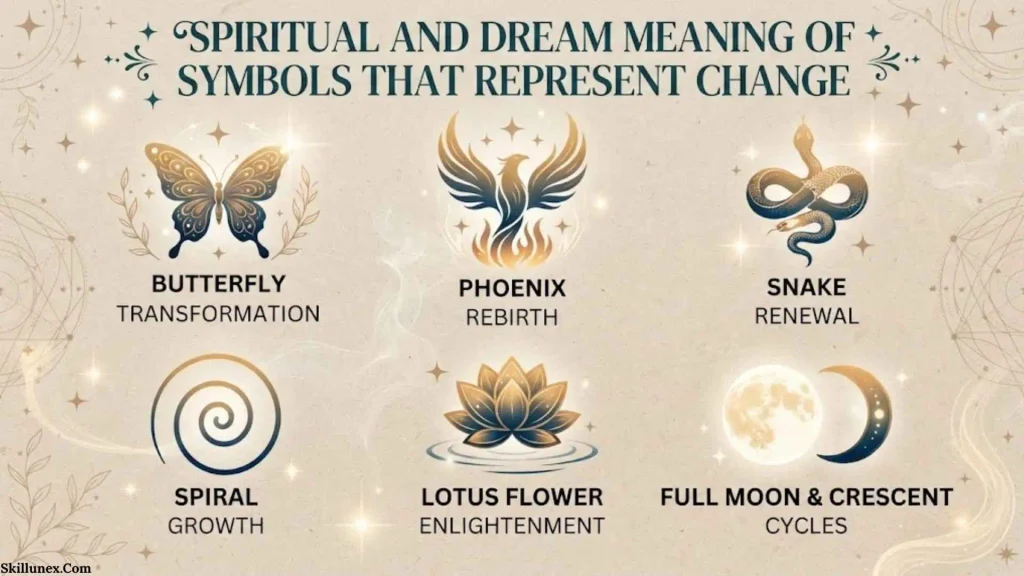
What Does It Mean to Dream About a Butterfly?
A butterfly in a dream may represent transformation, freedom, beauty, vulnerability, or a changing identity.
However, dream symbolism is personal.
A person who fears insects may experience a butterfly very differently from someone who associates butterflies with a loved one.
The strongest interpretation usually comes from asking:
What did the butterfly mean to you in the dream?
What Does a Phoenix Mean in a Spiritual Context?
A phoenix may symbolize the ability to rebuild after an ending.
People often connect it with:
- Resilience
- Spiritual renewal
- Recovery
- Forgiveness
- Personal rebirth
- Courage
- Starting over
It can be a powerful reminder that an ending does not always mean the end of the story.
What Does a Snake Mean Spiritually?
A snake can symbolize renewal because it sheds its skin.
It can also represent healing, instinct, wisdom, danger, sexuality, transformation, or hidden knowledge depending on the religious and cultural context.
There is no responsible way to say that every snake dream has one fixed spiritual meaning.
What Does the Lotus Mean in Meditation?
The lotus is often used as a visual metaphor for spiritual development.
Its roots remain in muddy water while the flower rises above it.
This can represent the idea that difficult experiences do not have to prevent growth.
In Buddhist and Hindu traditions, however, lotus symbolism is connected to specific religious frameworks that are much richer than the modern idea of “positive thinking.”
Positive and Negative Meanings of Symbols That Represent Change
| Positive Meaning | Negative Meaning |
| Growth | Fear of the unknown |
| Renewal | Loss |
| Freedom | Instability |
| Rebirth | Destruction |
| Adaptation | Confusion |
| New beginnings | Uncertainty |
| Healing | Grief |
| Spiritual awakening | Identity crisis |
| Courage | Forced change |
| Transformation | Resistance |
Why Can the Same Symbol Have Opposite Meanings?
Because change itself can be both beautiful and painful.
A butterfly may represent freedom, but it can also remind someone of a difficult period of personal change.
Fire can represent purification and renewal, but it can also represent destruction.
A snake can symbolize healing in one tradition and danger in another.
This is known as symbolic ambivalence.
A powerful symbol often contains both light and shadow.
Why Humans Are Attracted to Symbols That Represent Change
Humans naturally search for patterns.
When life becomes uncertain, patterns can create a sense of meaning.
Imagine someone moving to a new city after losing a job. They might choose a sunrise tattoo because it reminds them that every difficult night eventually leads to another morning.
The sunrise has not solved the problem.
But it has given the person a story through which to understand the problem.
Symbols Give Shape to Emotion
Words such as “growth” and “transformation” can feel abstract.
A butterfly makes transformation visible.
A falling leaf makes release visible.
A door makes opportunity visible.
A phoenix makes resilience visible.
That is why symbols remain useful even in modern societies filled with technology and scientific knowledge.
Symbols Connect Personal Experience With Cultural Memory
A person may choose a lotus because of a private experience, while also drawing from centuries of religious and artistic symbolism.
The personal meaning and cultural meaning can exist together.
This is one reason symbols are so emotionally powerful.
Symbols Help People Mark Life Transitions
Humans have long marked transitions through ceremonies and objects.
Birth, adulthood, marriage, death, initiation, migration, and religious conversion can all involve symbolic acts.
Modern people continue this practice in new forms.
A tattoo, piece of jewelry, memorial object, photograph, or piece of artwork can mark the moment when one chapter ends and another begins.
Modern Uses of Symbols That Represent Change
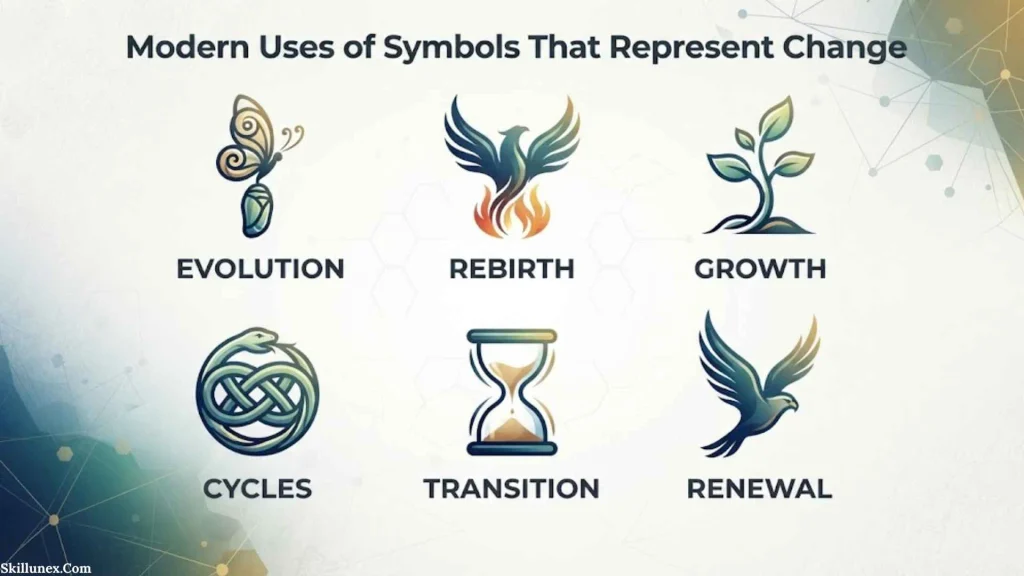
Tattoos
Change symbols are popular tattoo choices because they can tell a personal story without words.
A butterfly can say, “I became someone new.”
A phoenix can say, “I survived.”
A falling leaf can say, “I learned to let go.”
Jewelry
A symbolic pendant can serve as a daily reminder of a personal goal.
Many people choose symbols connected to resilience, spiritual growth, family, or new beginnings.
Fashion
Butterflies, moons, flowers, snakes, spirals, and celestial patterns appear regularly in fashion.
Some designs are chosen purely for their beauty. Others carry personal or cultural meanings.
Branding
Businesses use transformation symbolism to communicate innovation and progress.
Arrows suggest movement.
Leaves suggest renewal.
Rising shapes suggest growth.
Circular forms can suggest continuity.
The best branding symbolism works subtly rather than explaining itself too literally.
Social Media
Symbols of change are common in captions, profile images, inspirational posts, and personal announcements.
A sunrise may accompany a new beginning. A butterfly may represent healing. A mountain may represent overcoming a challenge.
Digital culture has turned ancient symbolic language into a fast visual vocabulary.
Contemporary Spirituality
Modern spiritual communities frequently use moon phases, crystals, lotus imagery, butterflies, sacred geometry, spirals, and phoenix imagery.
These meanings can be personally meaningful, but they should not automatically be presented as ancient facts. Some modern interpretations are recent developments rather than traditional teachings.
Home Decor
People use symbolic artwork to create emotional reminders in their homes.
A tree can represent a family.
A sunrise can represent hope.
A lotus can represent calm and spiritual growth.
A circular design can represent continuity.
The meaning comes partly from the object itself and partly from the story the owner gives it.
Interesting Facts About Symbols That Represent Change
- The butterfly has a remarkable linguistic connection to the soul. In ancient Greek, the word psyche was associated with both “butterfly” and “soul,” helping connect butterfly imagery with the human spirit.
- The ancient Egyptian Bennu and the Greek phoenix are related but not identical. It is more accurate to say that Egyptian bird symbolism contributed to the development of later phoenix traditions than to treat them as exactly the same creature.
- The lotus was connected with rebirth in ancient Egypt. Its daily opening and closing helped make it a powerful image of renewal.
- The scarab became a symbol of rebirth. Its connection with the rising sun and the emergence of young beetles contributed to its association with renewal in ancient Egypt.
- The ouroboros has no obvious beginning or ending. That circular structure makes it especially effective as an image of cyclical time and renewal.
- Yin-yang is not simply a symbol of good versus evil. Its philosophical background is based on complementary forces that interact and transform.
- The Māori koru comes from a natural growth pattern. It is based on the spiral form of an unfurling fern frond and has become a major motif in Māori art.
- Janus gave January its name. The Roman god’s association with beginnings and transitions helped make him an enduring symbol of looking backward and forward at the same time.
- A symbol can change meaning over time. A historical symbol may be adopted by new communities and acquire meanings that were not part of its original context.
- The most powerful symbols often describe a process, not a final state. The butterfly does not simply represent “being transformed.” It represents the journey from one form to another.
Frequently Asked Questions
What is the strongest symbol of change?
The butterfly is one of the most widely recognized symbols of transformation because its life cycle visibly moves through several dramatically different forms. The phoenix is another powerful choice, especially when the intended meaning is rebirth after destruction or hardship.
What symbolizes change and new beginnings?
Common symbols of change and new beginnings include the sunrise, butterfly, phoenix, lotus, sprouting seed, new moon, open door, spring season, and unfurling fern. The best choice depends on the kind of new beginning you want to represent.
What animal symbolizes transformation?
The butterfly is perhaps the clearest animal symbol of transformation because it undergoes metamorphosis. Snakes can symbolize renewal because they shed their skin, while koi can represent perseverance and transformation in East Asian folklore.
What flower represents change and growth?
The lotus is one of the strongest flowers associated with growth and spiritual transformation. Its imagery is important in ancient Egyptian, Hindu, and Buddhist traditions. Cherry blossoms can also represent impermanence and the temporary nature of beauty, particularly in Japanese cultural contexts.
What symbol represents starting over?
The phoenix is a powerful symbol for starting over after destruction or hardship. A sunrise, new moon, open door, or sprouting seed can also represent a fresh start without the stronger association with destruction found in phoenix symbolism.
What symbol represents personal transformation?
The butterfly is a strong choice for personal transformation, while the snake can represent shedding an old identity. The lotus is often chosen for spiritual growth, and the phoenix is particularly suitable for resilience after a major life crisis.
Conclusion
Symbols that represent change remind us that transformation is one of the oldest human experiences. From the Egyptian scarab and lotus to the Greek butterfly, Roman Janus, Chinese yin yang, Māori koru, and modern phoenix tattoo, people have always searched for images that make change easier to understand.
Some symbols tell us to let go. Others tell us to endure, grow, begin again, or trust the next stage of the journey. Perhaps that is why these symbols remain powerful after thousands of years. They give a visible shape to something every human being eventually faces.Change may close one chapter, but it can also be the doorway through which the next one begins.

Isla Kensington
I’m Isla Kensington, a writer with a passion for research, culture, nature, and the fascinating meanings behind everyday things. I enjoy taking topics that may seem simple at first and discovering the history, facts, and ideas that make them more interesting.
I write with readers in mind. My aim is to provide clear explanations, useful information, and interesting details without making a topic unnecessarily complicated.
I believe learning should feel like discovering something rather than simply reading facts. That philosophy guides the content I create and the topics I choose to explore.
## Books by Isla Kensington
* Symbols Around the World: A Guide to Meaning & Culture
* Nature’s Beautiful Places: Lakes, Landscapes & Natural Treasures