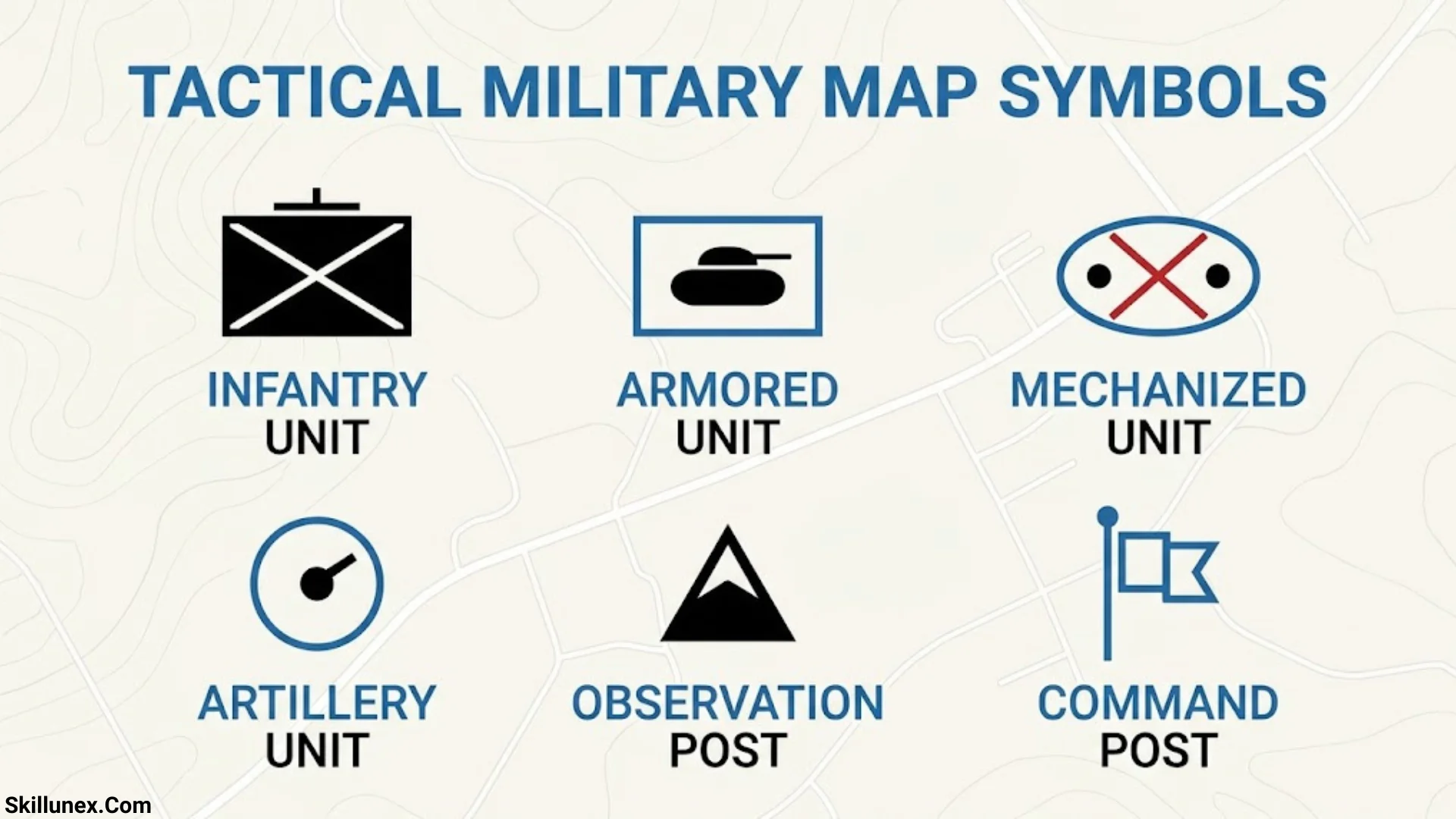
Tactical military map symbols are an essential part of military cartography, providing a standardized visual language for representing military units, equipment, activities, and other battlefield related information. These symbols help military personnel, researchers, historians, and students understand complex military maps without relying on lengthy written descriptions.
Unlike conventional maps that primarily display geographical features such as roads, rivers, mountains, and buildings, tactical military maps contain additional graphical information about military organizations and their identities. Symbols, colors, shapes, letters, and numbers work together to communicate information in a compact and recognizable format.
Understanding tactical military map symbols requires familiarity with their basic structure, affiliation indicators, unit categories, equipment representations, and standardized military symbology systems. Two important standards used in this field are NATO APP-6 and the United States MIL-STD-2525.
What Are Tactical Military Map Symbols?
Tactical military map symbols are standardized graphical representations used to identify military units, formations, equipment, installations, and activities on military maps and digital mapping systems.
They are designed to communicate military information quickly and consistently. Instead of writing a complete description beside every military formation, a mapmaker can use a recognized symbol to represent the relevant information.
For example, a military map may use different symbols to distinguish an infantry organization from an armored unit, artillery formation, or military headquarters.
These symbols can contain several types of information, including:
- Affiliation: Whether an entity is friendly, hostile, neutral, or unknown.
- Function: The general military category or type of organization.
- Size: The organizational echelon or level of a military unit.
- Identification: Additional information identifying a particular unit or formation.
- Status: Information about the condition or operational status of an entity.
- Location: The geographical position represented by the symbol.
Military symbols are not simply decorative markings. They follow defined conventions so that users familiar with the applicable standard can interpret information consistently.
History and Development of Military Map Symbols
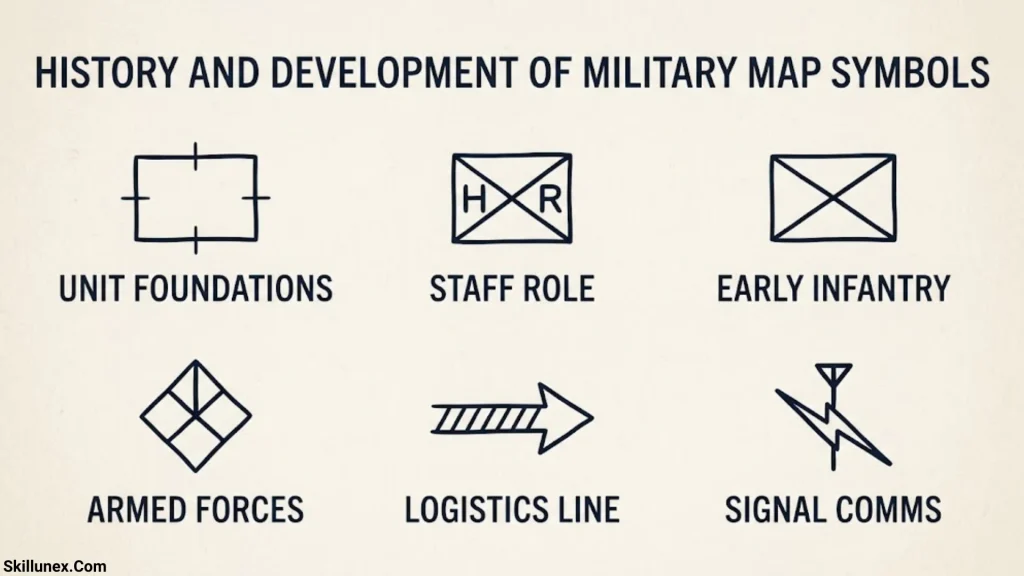
Military map symbols have developed alongside military cartography and the increasing need for standardized communication.
Early military maps frequently relied on simple drawings, abbreviations, flags, and manually created markings to identify military positions and formations. However, differences between national mapping conventions sometimes made it difficult for different organizations to interpret one another’s maps.
As military organizations became more technologically advanced, the need for consistent graphical standards increased.
Modern military symbology evolved to support printed maps, operational overlays, command-and-control systems, and computerized geographic information systems.
Today, standardized military symbols are used in both traditional map products and digital operational displays. Their development has also supported interoperability between military organizations that follow compatible standards.
Main Categories of Tactical Military Map Symbols
Tactical military map symbols cover several categories of military information. Understanding these categories is the first step toward reading and interpreting a military map.
Friendly Force Symbols
Friendly force symbols represent military organizations or entities identified as belonging to one’s own forces or allied organizations.
They may represent different military branches, unit types, and organizational levels.
Examples include:
- Infantry organizations
- Armored formations
- Artillery units
- Engineering organizations
- Aviation units
- Logistics organizations
- Medical units
- Military headquarters
Friendly force symbols are generally displayed using blue in conventional military map color schemes. However, actual color conventions depend on the applicable symbology standard and display settings.
Hostile or Enemy Force Symbols
Hostile force symbols represent military entities identified as opposing forces.
They help distinguish hostile organizations from friendly and other categories on a military map.
Examples include:
- Infantry units
- Armored formations
- Artillery organizations
- Military aviation units
- Naval organizations
- Other identified hostile military entities
Red is commonly used to represent hostile affiliation in standard military map displays.
It is important to understand that the color indicates affiliation, not necessarily the type or strength of the represented organization. The internal symbol and associated information provide additional identification.
Neutral Force Symbols
Neutral force symbols represent entities that are not classified as friendly or hostile within the applicable operational context.
Neutral entities may include organizations or forces whose status is recognized as neutral.
Green is commonly associated with neutral affiliation in traditional military symbology.
These symbols help distinguish neutral entities from other affiliation categories.
Unknown and Suspect Force Symbols
Sometimes the identity or affiliation of an entity cannot be established with confidence.
Military symbology provides categories for representing uncertainty, including unknown and suspect affiliations.
Yellow is commonly associated with unknown affiliation in conventional military map displays.
The distinction between an unknown entity and a suspect entity depends on the applicable standard and the available identification information.
These categories are important because an entity’s identity should not be assumed when sufficient information is unavailable.
Understanding the Structure of Tactical Military Map Symbols
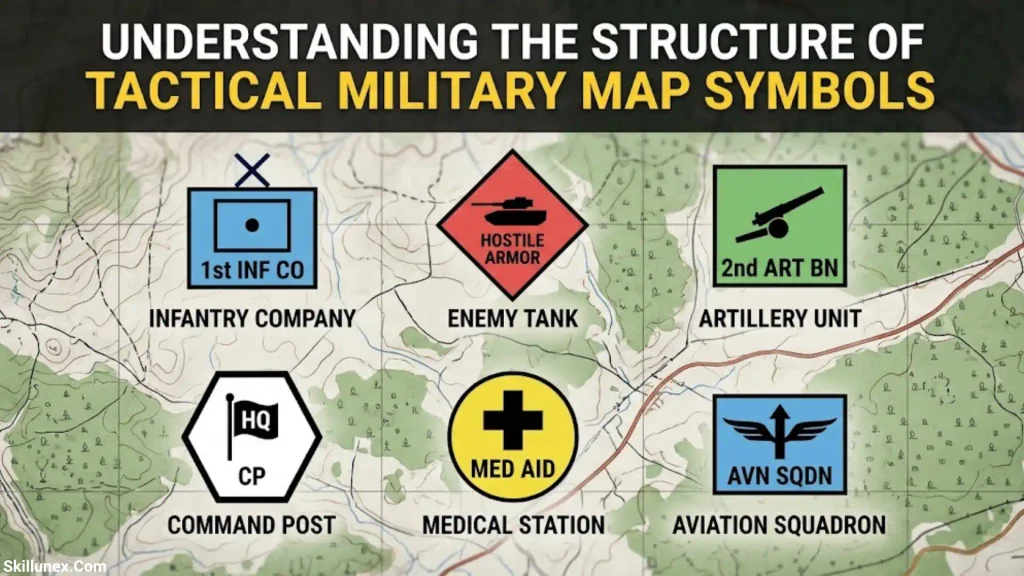
A tactical military map symbol is generally made up of multiple graphical elements. Each element contributes to the overall meaning of the symbol.
Symbol Frame
The frame is the outer geometric shape surrounding the main symbol.
It commonly communicates the affiliation or identification category of the represented entity.
Depending on the applicable symbology standard, frames may include rectangular, diamond-shaped, circular, or other defined forms.
The frame should not be interpreted in isolation. It must be considered together with the internal icon and additional modifiers.
Internal Icon
The internal icon, also called the basic symbol or function indicator, identifies the general type of entity being represented.
For example, an internal icon may indicate an infantry organization, armored formation, artillery category, or another military function.
These icons are designed to communicate the nature of an entity without requiring a complete written description.
Symbol Color
Color is an important visual element because it helps users distinguish affiliations and categories.
Common traditional color conventions include:
| Color | Common affiliation meaning |
| Blue | Friendly |
| Red | Hostile |
| Green | Neutral |
| Yellow | Unknown |
These conventions are widely recognized, but users should consult the relevant standard because symbol presentation can vary between systems.
Unit Size and Echelon Indicators
Military symbols may include additional markings that identify the organizational size or echelon of a unit.
An echelon indicator helps distinguish different levels of military organization.
Common organizational levels include:
- Team
- Squad
- Section
- Platoon
- Company
- Battalion
- Regiment
- Brigade
- Division
- Corps
- Army
The exact graphical markings used to identify these levels depend on the applicable military symbology standard.
Additional Modifiers and Labels
Modifiers and labels provide supplementary information about the represented entity.
Depending on the standard and symbol type, they may communicate:
- Unit designation
- Higher formation
- Equipment quantity
- Operational status
- Specialization
- Identification details
- Other relevant characteristics
Not every symbol contains all these elements. Their placement and interpretation depend on the applicable symbology rules.
Common Types of Military Unit Symbols
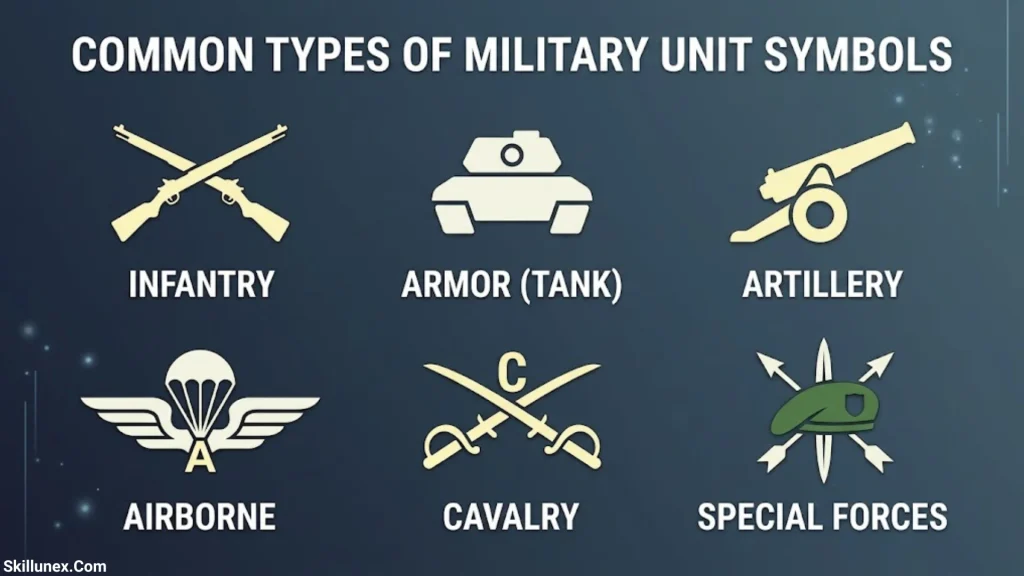
Military unit symbols represent organizational entities rather than individual geographical features.
They help readers distinguish different military functions and organizational categories.
Infantry Unit Symbols
Infantry symbols represent military organizations whose primary function involves infantry operations.
They may appear at different organizational levels, including platoons, companies, battalions, and larger formations.
Infantry organizations may also have specialized roles, such as mechanized or light infantry, depending on the military classification system.
Armored Unit Symbols
Armored unit symbols represent organizations associated with armored fighting vehicles and related military formations.
Examples include:
- Tank units
- Armored reconnaissance organizations
- Armored formations
- Mechanized military organizations
These symbols distinguish armored military categories from other organizational types.
Artillery Unit Symbols
Artillery symbols represent military organizations associated with artillery systems.
They may identify different organizational categories, including conventional artillery and other specialized artillery formations.
The exact classification depends on the symbology standard being used.
Engineer Unit Symbols
Engineer symbols identify military organizations associated with engineering functions.
Examples include military construction, mobility support, infrastructure work, and other engineering related activities.
Aviation Unit Symbols
Aviation symbols represent military aviation organizations and related entities.
These may include organizations associated with fixed-wing aircraft, helicopters, and other military aviation functions.
Logistics and Support Unit Symbols
Military logistics symbols identify organizations responsible for supporting military operations.
These organizations may provide transportation, maintenance, supply, medical services, and other administrative or logistical functions.
Headquarters Symbols
Headquarters symbols identify military command organizations.
They may represent different organizational levels, such as battalion, brigade, division, corps, and higher headquarters.
The symbol’s additional markings and labels help communicate its organizational identity.
Military Equipment and Vehicle Symbols
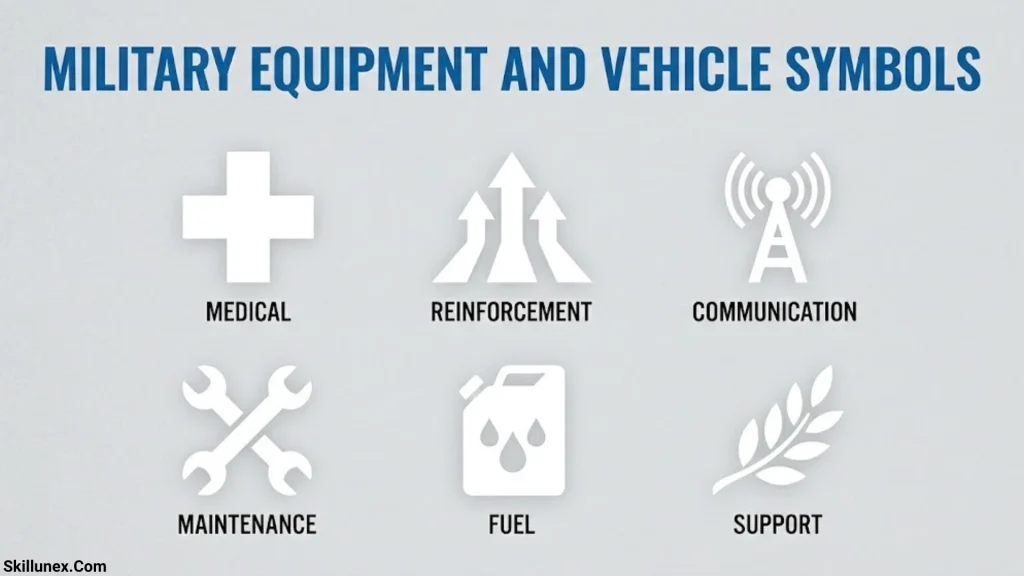
Military equipment symbols represent specific categories of military hardware rather than organizational units.
These symbols are useful in military cartography because they allow different equipment types to be represented using standardized graphical conventions.
Main Battle Tank Symbols
Tank symbols identify main battle tanks and related armored vehicle categories.
They are distinct from general infantry or headquarters symbols because they represent equipment rather than an organizational headquarters or unit.
Armored Personnel Carrier Symbols
Armored personnel carrier symbols represent vehicles designed to transport military personnel while providing varying degrees of protection.
They should be distinguished from symbols representing infantry formations that may operate alongside such vehicles.
Artillery Equipment Symbols
Artillery equipment symbols represent artillery-related hardware, including different categories of gun and rocket artillery systems.
The specific icon and associated modifiers determine the represented equipment category.
Military Aircraft Symbols
Aircraft symbols represent military aviation equipment.
Depending on the standard, they may distinguish fixed-wing aircraft, helicopters, and other aviation categories.
Military Transport Vehicle Symbols
Military transport vehicle symbols represent equipment used for transporting personnel, materials, or supplies.
They are particularly relevant to logistics-related military mapping.
Military Map Symbols for Installations and Geographic Features
Not every military map symbol represents a military unit or vehicle. Some symbols identify installations, facilities, and geographical information.
Military Installations
Military installation symbols may represent recognized military facilities and infrastructure.
Examples include:
- Military bases
- Airfields
- Naval facilities
- Command facilities
- Logistics installations
- Military training areas
Communication Facilities
Communication related symbols may identify facilities or systems associated with military communications.
Their exact representation depends on the applicable symbology standard.
Obstacles and Geographic Features
Military mapping can also include symbols for obstacles and other terrain-related information.
Examples include rivers, bridges, roads, barriers, and other features relevant to geographical interpretation.
These features should be distinguished from tactical unit symbols because they represent environmental or infrastructure information rather than military organizations.
NATO APP 6 Military Map Symbol Standard
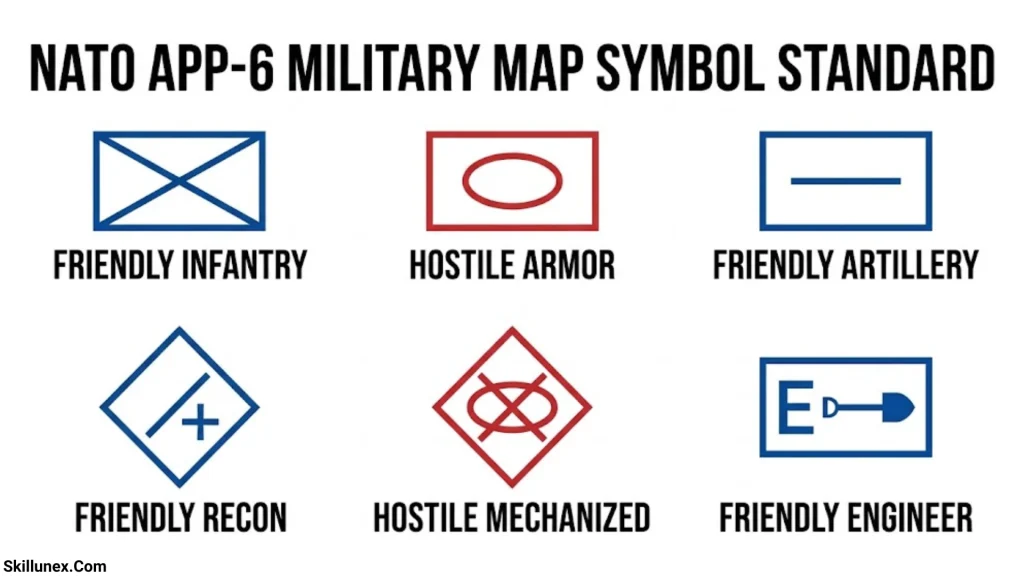
NATO APP-6 is an important standard for military symbology.
It establishes conventions for representing military units, equipment, activities, and other entities in a consistent visual format.
Its purpose is to improve the exchange and interpretation of military information among NATO members and organizations using compatible systems.
Main Features of NATO APP 6
The standard provides conventions for:
- Military affiliation categories
- Unit and equipment symbols
- Graphical frames
- Symbol modifiers
- Organizational echelon indicators
- Additional identification information
- Standardized military graphical representation
APP-6 has evolved through multiple editions. Therefore, the precise appearance and availability of individual symbols can depend on the version being used.
Why NATO APP 6 Is Important
NATO APP-6 supports interoperability by providing a shared symbology framework.
When different organizations use compatible versions and implementations, military information can be represented and interpreted more consistently.
The standard is also relevant to military education, defense research, digital mapping, and military cartography.
US MIL STD 2525 Military Symbol Standard
MIL-STD-2525 is a United States military standard that defines common warfighting symbology.
It supports the graphical representation of military information across operational displays and compatible command-and-control systems.
Main Features of MIL-STD-2525
The standard includes conventions for representing:
- Military units
- Equipment
- Installations
- Military activities
- Affiliation categories
- Symbol modifiers
- Additional identification information
Like NATO APP-6, MIL-STD-2525 has undergone revisions over time.
Users should consult the specific edition relevant to their mapping application rather than assuming that every version contains identical symbols or formatting rules.
Differences Between NATO APP-6 and MIL-STD-2525
NATO APP-6 and US MIL-STD-2525 share many concepts and have influenced the development of interoperable military symbology.
However, they are not automatically identical in every detail.
| Feature | NATO APP-6 | US MIL-STD-2525 |
| Primary association | NATO military symbology | United States military symbology |
| Main purpose | Standardized military representation | Common warfighting symbology |
| Applications | NATO and compatible systems | US military and compatible systems |
| Symbol categories | Units, equipment, activities, and other entities | Units, equipment, activities, and other entities |
| Revisions | Multiple editions | Multiple revisions |
| Interoperability | Supports compatible NATO systems | Supports compatible implementations |
The two standards share a common goal: consistent graphical communication of military information.
How to Read and Interpret Tactical Military Map Symbols
Learning to interpret tactical military map symbols becomes easier when you examine their components in a consistent order.
Identify the Affiliation
First, identify the affiliation category indicated by the symbol’s frame and color.
Determine whether the represented entity is friendly, hostile, neutral, or unknown.
Do not rely on color alone, particularly when viewing printed documents or maps with limited color reproduction.
Examine the Internal Icon
Next, identify the internal graphical icon.
This helps establish whether the symbol represents a military unit, equipment category, installation, or another type of entity.
Check the Echelon Indicator
If the symbol represents an organizational unit, look for any echelon indicators.
These markings help establish the organizational level being represented.
Read Additional Labels
Finally, examine the additional text, letters, numbers, and modifiers.
These may provide unit identification, designation, status, or other relevant information.
Consult the Applicable Legend
Always check the map legend and relevant symbology standard.
A symbol’s meaning may depend on its context, version, and implementation.
Common Mistakes When Interpreting Military Map Symbols
Even experienced readers can misunderstand military symbology when they overlook important details.
Assuming All Military Symbols Are Universal
Not every country or military organization uses precisely the same symbol conventions.
NATO APP-6 and MIL-STD-2525 provide important common frameworks, but their editions and implementations can differ.
Confusing Affiliation With Unit Type
The frame and color commonly communicate affiliation, while the internal icon identifies the general type of entity.
These elements serve different purposes and should not be confused.
Ignoring Echelon Indicators
A military symbol may identify a unit’s general function without communicating its organizational level unless the echelon marking is also examined.
Confusing Equipment With Military Units
A tank equipment symbol and an armored unit symbol do not necessarily represent the same thing.
One represents a category of equipment, while the other represents an organization.
Ignoring the Map Legend
The legend provides essential information about the symbols used in a particular map.
Ignoring it can result in incorrect interpretations, especially when the map uses a specialized or modified symbology system.
Applications of Tactical Military Map Symbols
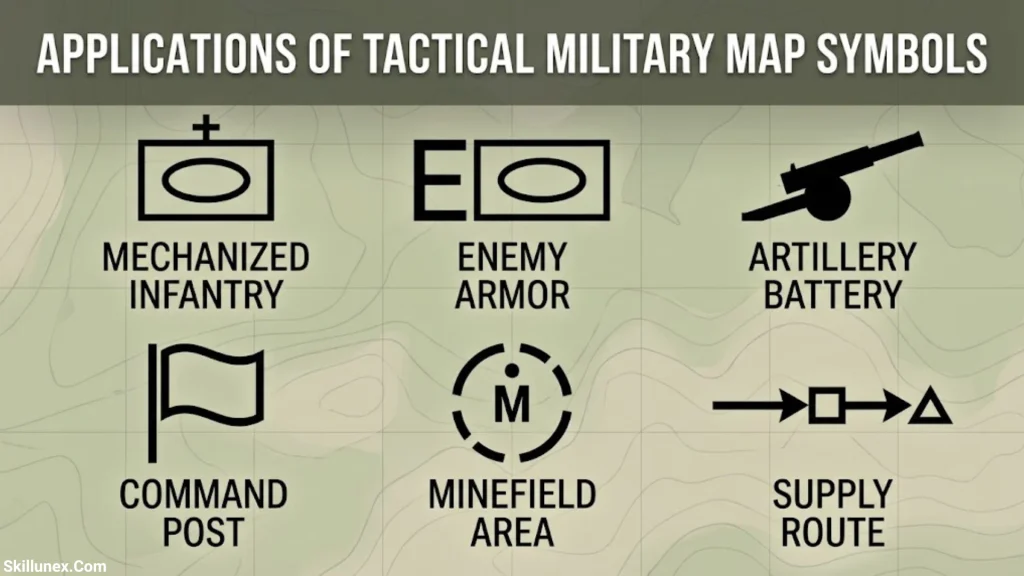
Tactical military map symbols have applications beyond conventional printed military maps.
Military Education and Training
Military schools and educational institutions use standardized symbols to teach military geography, map interpretation, and cartographic conventions.
Military History Research
Historians and researchers use military symbols to interpret historical maps, understand organizational representations, and study military documents.
Geographic Information Systems
Military symbology can be integrated into geographic information systems (GIS) to represent military-related information in digital mapping environments.
Defense Research and Analysis
Researchers use standardized military symbols when examining military organizations, defense documentation, and historical or educational datasets.
Military Simulation and Training Software
Simulation systems may use standardized graphical representations to display military entities and other information in training environments.
Digital Command and Control Displays
Compatible digital systems can use military symbology to present structured information in a consistent graphical format.
Benefits of Standardized Tactical Military Map Symbols
Standardized military symbology provides several important benefits.
- Faster recognition: Graphical symbols allow readers to identify information without reading lengthy descriptions.
- Consistent communication: Standardized conventions reduce differences in interpretation between compatible organizations.
- Improved map readability: Symbols present complex information in a compact visual format.
- Better interoperability: Compatible standards support the exchange of graphical information between different systems.
- Efficient information presentation: A single symbol can communicate several categories of information.
- Educational value: Standardized symbols provide a structured foundation for learning military cartography.
How to Learn Tactical Military Map Symbols
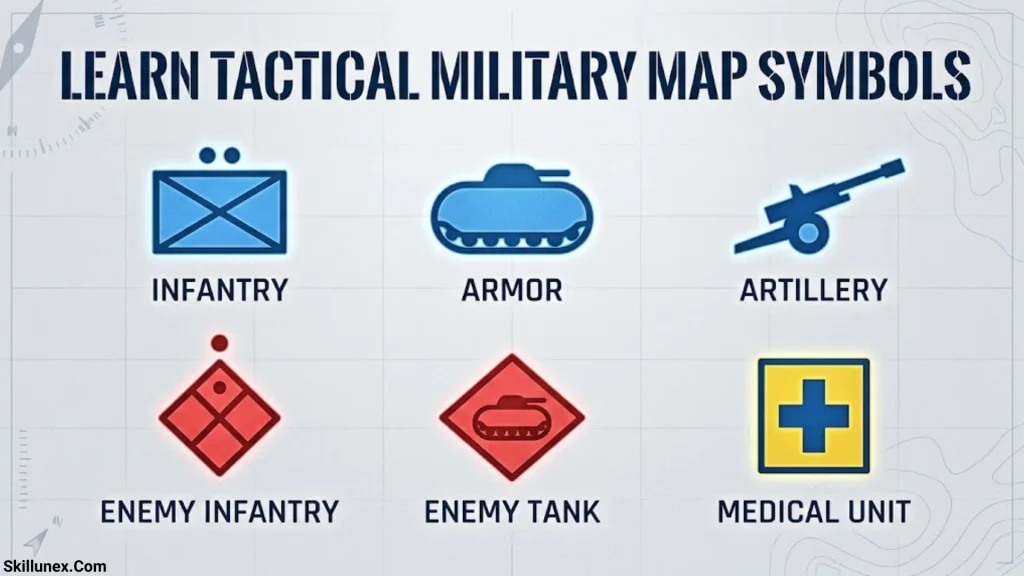
Learning military symbology requires a combination of theoretical knowledge and practical interpretation.
Start With Basic Affiliation Categories
Learn the difference between friendly, hostile, neutral, and unknown affiliations.
Understanding these categories provides a foundation for interpreting more complex symbols.
Study Basic Symbol Components
Become familiar with frames, internal icons, colors, echelon markings, and additional modifiers.
Understanding how these components work together makes symbol interpretation easier.
Learn Military Organizational Levels
Study common military organizational terms such as platoon, company, battalion, brigade, division, and corps.
This will help you understand the organizational information represented by echelon indicators.
Compare Different Symbology Standards
Explore NATO APP-6 and US MIL-STD-2525 to understand their common principles and differences.
Pay attention to the edition or revision referenced in each learning resource.
Practice With Educational Military Maps
Use publicly available historical maps, educational examples, and official reference documents to develop your understanding.
Always refer to the relevant legend when interpreting unfamiliar symbols.
Frequently Asked Questions About Tactical Military Map Symbols
What are tactical military map symbols?
Tactical military map symbols are standardized graphical markings used to represent military units, equipment, installations, affiliations, and other military-related information on maps and digital displays.
What do colors mean on tactical military maps?
Common traditional conventions use blue for friendly forces, red for hostile forces, green for neutral forces, and yellow for unknown forces. Actual presentation may vary according to the applicable symbology standard and software configuration.
What is the difference between a military unit symbol and an equipment symbol?
A military unit symbol represents an organization, such as an infantry company or armored battalion. An equipment symbol represents a category of military hardware, such as a tank or aircraft.
What is NATO APP-6?
NATO APP-6 is a military symbology standard that establishes conventions for representing military units, equipment, activities, and other entities.
What is MIL-STD-2525?
MIL-STD-2525 is a United States military standard for common warfighting symbology used in military mapping and compatible command-and-control systems.
Are NATO APP-6 and MIL-STD-2525 the same?
No. They are related standards that share many concepts and interoperability goals, but their specific editions, symbol definitions, and implementation details may differ.
What is an echelon indicator in military symbology?
An echelon indicator is a graphical marking that communicates the organizational level of a military unit, such as platoon, company, battalion, brigade, or division.
Why are military map symbols important?
They provide a standardized way to communicate military information visually, improve map readability, support interoperability, and reduce the need for lengthy written descriptions.
Can civilians learn tactical military map symbols?
Yes. Military symbology is a subject that can be studied by civilians, students, historians, researchers, and anyone interested in military cartography.
Where can I find official military map symbol references?
Useful reference materials include NATO APP-6 documentation, publicly available US MIL-STD-2525 documents, military cartography publications, and educational resources explaining standardized military symbology.
Conclusion
Tactical military map symbols are a fundamental component of military cartography. They provide a structured visual language for representing military units, equipment, installations, affiliations, and other relevant information.
Understanding their frames, internal icons, colors, echelon indicators, and additional modifiers makes military maps easier to interpret. Familiarity with NATO APP-6 and US MIL-STD-2525 also helps readers understand the importance of standardized military symbology and interoperability.
If your interest is military education, historical research, geographic information systems, or defense related cartography, learning tactical military map symbols provides a strong foundation for understanding how military information is represented visually.

I’m Adrian Holloway, a writer and researcher who enjoys exploring the stories, meanings, and interesting facts behind the subjects people search for every day. I’m especially interested in symbols, nature, lakes, places, and cultural topics that help readers understand the world from a different perspective.
I believe useful content should be simple, accurate, and enjoyable to read. When I research a topic, I focus on finding meaningful details and presenting them in a way that makes information easy to understand.
My goal is to create helpful articles that answer real questions while encouraging readers to discover something new with every visit.
Books by Adrian Holloway
The Language of Symbols: Meanings, Stories & Traditions
Hidden Wonders of Nature: Lakes, Landscapes & Discovery