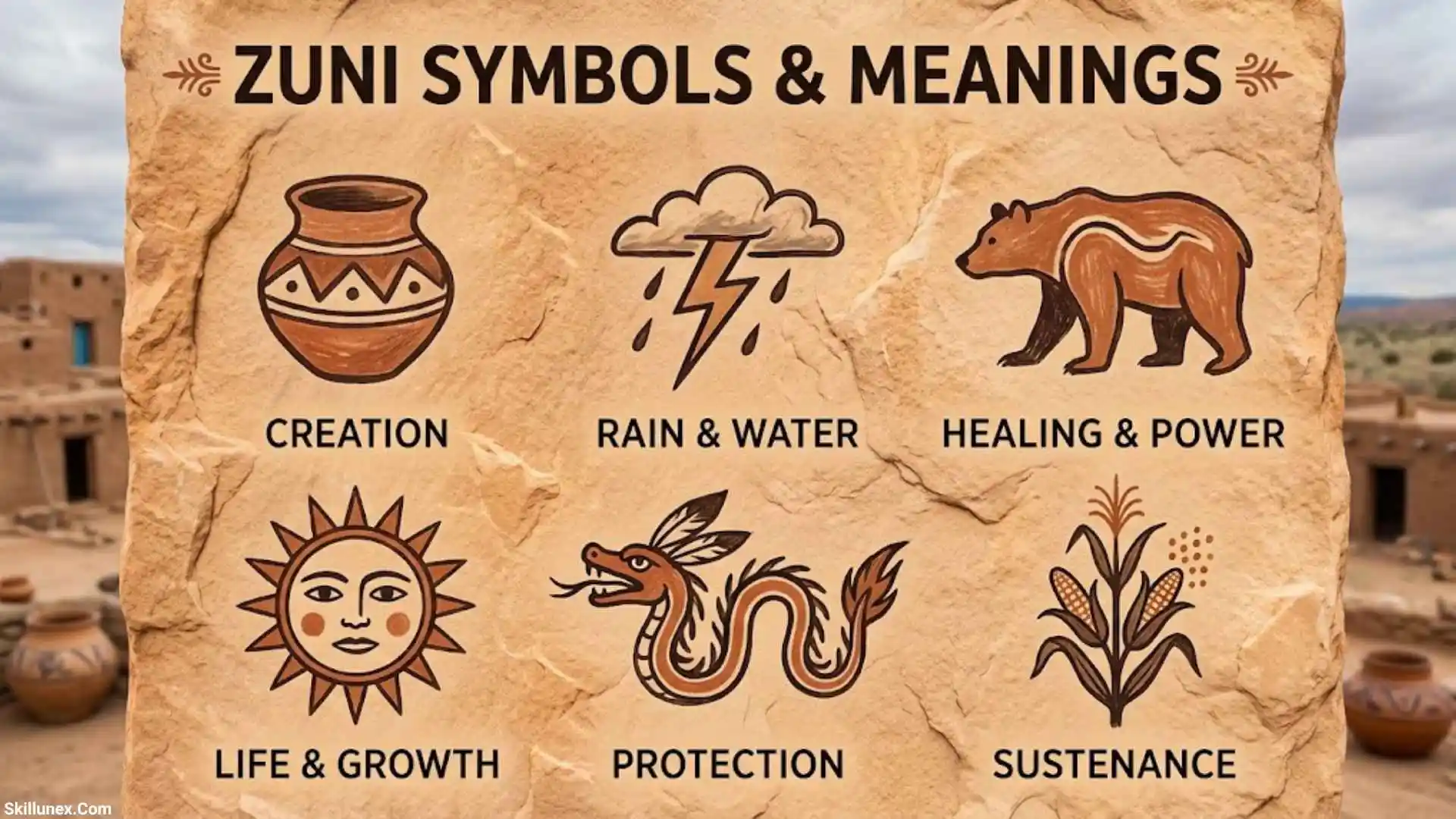
Zuni symbols and meanings offer a fascinating look into the history, beliefs, art, and traditions of the Zuni people. Also known as the A:shiwi, the Zuni are an Indigenous people whose ancestral homeland is in the American Southwest, particularly in present-day New Mexico. Their cultural heritage includes pottery, stone carvings, jewelry, storytelling, and ceremonial traditions.
When I explore Zuni symbols, I see how closely art and culture can connect people with their surroundings. You may come across animal carvings, turquoise jewelry, geometric patterns, and designs inspired by nature. However, understanding these symbols requires more than assigning a simple meaning to each shape. Their significance can depend on the artist, the object, and the cultural context in which a design appears.
In this guide, you’ll learn about common Zuni artistic motifs, animal carvings, turquoise jewelry, traditional art forms, and the cultural ideas associated with them. You’ll also discover how to distinguish documented Zuni traditions from general interpretations that may not accurately reflect Zuni beliefs.
What Are Zuni Symbols and Meanings?
Zuni symbols are visual representations, artistic motifs, and culturally meaningful designs associated with the traditions of the Zuni people. They appear in different forms of art, including pottery, jewelry, carvings, and other handmade objects.
Some designs reflect the natural environment, while others may have cultural, spiritual, or ceremonial significance. Their meanings are not always universal. A particular animal or pattern may carry a specific meaning in one context but serve a primarily decorative purpose in another.
Zuni art is also a living tradition. Contemporary Zuni artists continue to create work that reflects their cultural heritage while expressing their individual creativity.
When you research Zuni symbols, remember that not every design has a documented symbolic meaning. It is important to distinguish between traditional cultural knowledge, an artist’s personal interpretation, and assumptions made by outside sources.
History and Cultural Significance of Zuni Symbols
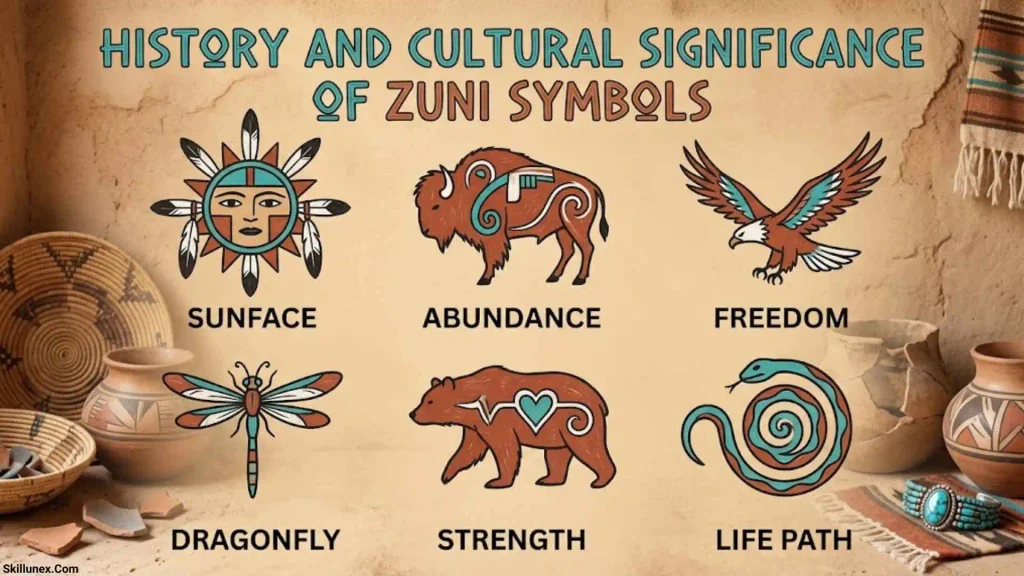
The Zuni people have a long history in the American Southwest. Their community, language, religious traditions, agricultural practices, and artistic skills have developed over generations.
Traditional art can preserve cultural knowledge and express relationships with the land, animals, community, and spiritual life. Pottery, stone carving, and jewelry are important examples of artistic practices associated with Zuni heritage.
Connection to Nature
The natural environment plays an important role in the lives and traditions of many Southwestern Indigenous communities. Animals, plants, rainfall, water, and agricultural cycles are meaningful subjects in regional art.
Zuni artistic traditions reflect this relationship with the environment. However, the precise meaning of a natural motif should be understood within its particular cultural context rather than assumed from its appearance alone.
Spiritual and Ceremonial Traditions
Zuni religious and ceremonial traditions are important aspects of community life. Certain objects, designs, and representations may be associated with specific beliefs or ceremonies.
Not all ceremonial knowledge is intended for unrestricted public interpretation. For this reason, it is respectful to rely on information shared by Zuni cultural authorities, knowledgeable community members, and trustworthy educational sources.
Artistic Expression and Identity
Zuni art also expresses individual creativity and cultural identity. Artists use materials, techniques, and designs that reflect their skills and artistic choices.
A piece of jewelry or a carving may have personal meaning to its creator, even when that meaning is not part of a widely documented symbolic tradition.
Common Zuni Symbols and Their Meanings
Different motifs appear in Zuni art, but their interpretations vary. The following sections explain common artistic themes and the care needed when discussing their meanings.
Animal Imagery
Animal forms are prominent in many Southwestern Indigenous artistic traditions, including Zuni carving. Animals may be represented because of their relationship with the natural environment, cultural stories, or particular traditional beliefs.
An animal’s appearance alone does not establish its precise meaning. To interpret a specific Zuni design accurately, consider the source, the artist’s explanation, and the context in which it is used.
Bear Imagery
Bear figures appear in various Indigenous artistic traditions and may be associated with strength, protection, or other qualities in particular cultural contexts.
These associations should not automatically be presented as universal Zuni meanings. A bear carving made by a Zuni artist may have a specific interpretation that is best understood through the artist’s explanation or reliable cultural documentation.
Eagle Imagery
Eagles have cultural and spiritual importance in numerous Indigenous traditions. Their representation can be connected with different beliefs, stories, and practices depending on the community.
When you encounter an eagle motif attributed to Zuni art, avoid assuming that its meaning is identical to an eagle symbol from another Indigenous nation.
Deer Imagery
Deer are part of the natural environment of the American Southwest and appear in regional art and storytelling.
A deer design may represent an animal itself, reflect an artist’s connection to the natural world, or have a more specific meaning in a particular context. Its interpretation depends on the artwork and its cultural background.
Bird Imagery
Birds appear in many forms of Indigenous Southwestern art. Different bird species may have distinct associations within particular traditions.
It is best to identify the specific bird, when possible, and consult information connected to the artist or cultural source rather than assigning one meaning to all bird designs.
Serpent Imagery
Serpent or snake imagery occurs in various Southwestern Indigenous traditions. Such imagery can have different meanings depending on its form and cultural context.
A snake motif should not automatically be interpreted as a symbol of healing, danger, renewal, or spirituality without evidence supporting that interpretation for the particular Zuni artwork.
Zuni Animal Fetishes and Their Meanings
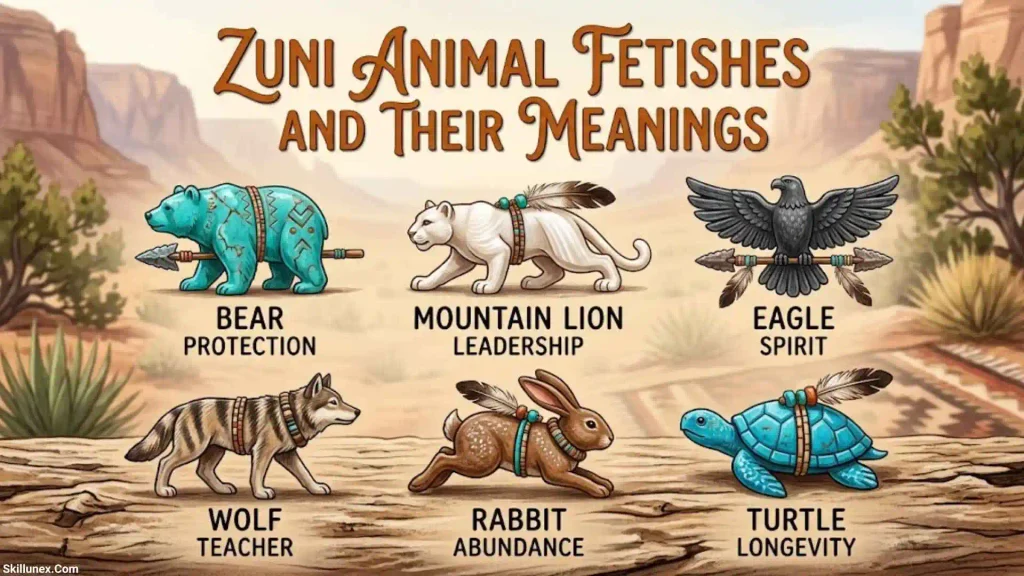
One of the best-known forms of Zuni art is the small animal carving commonly called a fetish. These carvings are often made from stone and may also incorporate materials such as shell or other natural substances.
Zuni artists are recognized for creating detailed representations of animals, including bears, birds, mountain lions, and other creatures. The carvings vary in style, material, and artistic purpose.
What Are Zuni Fetishes?
Zuni fetishes are carved objects associated with traditional Zuni cultural practices. The term is commonly used in descriptions of Zuni animal carvings, although it does not fully explain their cultural significance.
Some carvings have specific traditional associations, while others are created as contemporary art or collectible pieces. Their meaning should not be reduced to a generic list of spiritual powers.
Animal Carvings and Cultural Context
The animal depicted, the material used, the details of the carving, and the artist’s explanation can all help you understand a particular piece.
For example, a stone bear carving may be appreciated for its craftsmanship and artistic representation. If it also has a documented traditional significance, that meaning should be explained using a reliable source rather than assumed from the animal’s identity.
Why Zuni Fetishes Are Important
Zuni animal carvings demonstrate the skill and creativity of Zuni artists. They also provide an opportunity to learn about the community’s artistic heritage and the different ways traditional knowledge may be expressed through objects.
When you purchase or study a carving, consider learning about its maker and asking whether the artist has shared information about its intended meaning.
Zuni Symbols in Pottery
Pottery is another important part of Zuni artistic heritage. Traditional pottery can combine practical use, decorative design, and cultural expression.
Zuni pottery may feature painted patterns, geometric arrangements, and imagery inspired by the surrounding environment. The specific designs vary according to the artist, period, and purpose of the object.
Geometric Patterns in Zuni Pottery
Geometric patterns can include lines, repeated shapes, triangles, and other carefully arranged forms. Artists use these elements to create balance, rhythm, and visual interest.
Some patterns may have cultural associations, while others may primarily reflect artistic choices. It would be inaccurate to assume that every triangle, line, or repeated shape represents a particular spiritual concept.
Nature-Inspired Designs
Natural forms and environmental themes appear in the artistic traditions of the American Southwest. Depending on the piece, a design may reflect plants, animals, water, or other features of the natural world.
To understand a particular Zuni pottery design, look for information about the artist, the object’s history, and any documented explanation of its imagery.
The Importance of Traditional Craftsmanship
Zuni pottery represents knowledge and skills passed between generations, alongside the individual creativity of contemporary makers.
Its value is not limited to symbolic interpretation. Materials, production techniques, painted details, and the artist’s approach are also important parts of the artwork.
Zuni Symbols in Jewelry
Zuni jewelry is widely recognized for its detailed stonework and distinctive craftsmanship. Zuni artists have developed specialized techniques for shaping and arranging stones into intricate designs.
Common materials include turquoise, coral, shell, and other stones. These materials can be set into silver or combined in different arrangements to create earrings, rings, pendants, bracelets, and other pieces.
Turquoise in Zuni Jewelry
Turquoise is an important material in many Southwestern Indigenous jewelry traditions, including Zuni work. Its color and texture make it especially suitable for detailed inlay and stone-setting techniques.
The cultural significance of turquoise varies across communities and individual contexts. A turquoise stone in a Zuni piece should not automatically be assigned a single spiritual meaning.
Needlepoint Jewelry
Needlepoint is a Zuni jewelry technique involving small, narrow stones arranged in precise patterns. The stones are often shaped into pointed forms and set closely together.
The finished piece displays the artist’s attention to detail, symmetry, and stone selection. Needlepoint jewelry is particularly valued for the skill required to cut and arrange the stones.
Petit Point Jewelry
Petit point is another technique associated with Zuni jewelry. It generally uses small, rounded or oval-shaped stones arranged in carefully designed patterns.
Although needlepoint and petit point are related forms of detailed stonework, their stone shapes and overall appearance differ.
Inlay Jewelry
Inlay jewelry involves fitting pieces of stone and other materials into a design to create a smooth, patterned surface. Zuni artists are known for intricate inlay work that combines colors, shapes, and contrasting materials.
These designs may feature animals, geometric patterns, or other imagery. The meaning of a particular design depends on its source and the artist’s intentions.
Zuni Symbols Related to Rain and Water
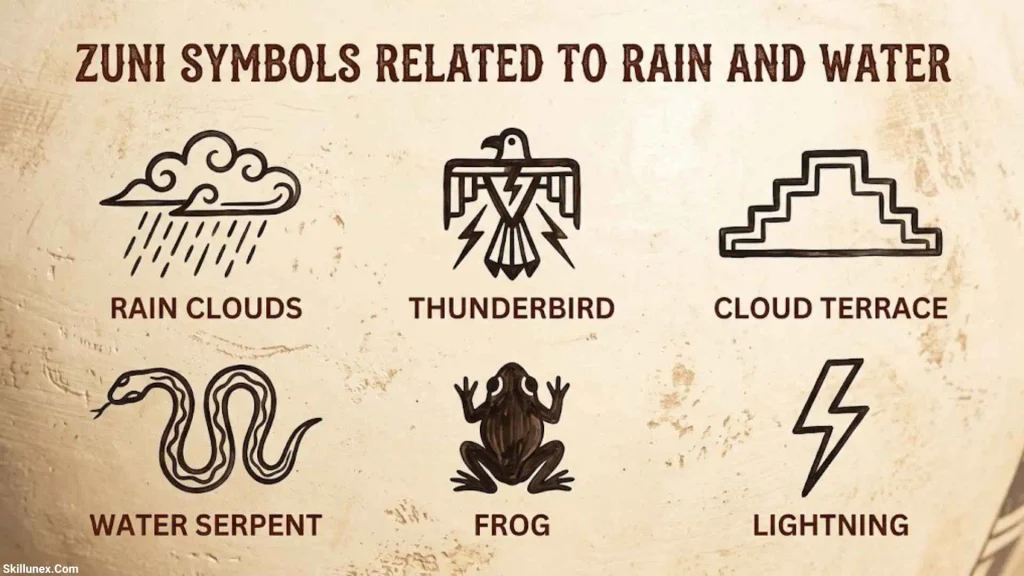
Rain and water are important subjects in the cultural life of Southwestern communities. Water supports people, animals, plants, and agriculture in an environment where rainfall can be limited.
Zuni traditions include cultural and ceremonial relationships with rain and agricultural well-being. However, not every wavy line, blue stone, or curved pattern in Zuni art should be identified as a rain or water symbol.
Rain in Southwestern Culture
Rain can be associated with the health of crops and the well-being of a community. These concerns are especially important in regions where agriculture depends on seasonal precipitation.
Specific Zuni ceremonies and beliefs have their own cultural contexts. General statements about rain symbolism should not replace community-specific explanations.
Water-Inspired Artistic Designs
Artists may use flowing lines, curved forms, or colors that remind viewers of water. Such visual similarities do not prove that a design has a particular traditional meaning.
When interpreting a pattern, look for documented information about the artwork instead of relying only on its visual appearance.
Zuni Symbols Related to Corn and Agriculture
Agriculture has long been important to Zuni life. Farming, seasonal cycles, and the cultivation of crops connect communities with the land and the natural environment.
Corn is significant in many Indigenous cultures of the Americas, including communities throughout the Southwest. Its importance may be reflected in cultural practices, stories, art, and ceremonial traditions.
The Cultural Importance of Corn
Corn provides food and has a long history in Indigenous agriculture. Its cultivation is connected with knowledge about soil, seasons, rainfall, and local growing conditions.
Within Zuni culture, agricultural traditions are part of a broader relationship among community life, the land, and cultural beliefs.
Corn Imagery in Art
Some artworks may include plant-related designs or imagery associated with agriculture. However, a particular pattern should not be identified as a Zuni corn symbol unless its meaning is supported by reliable cultural information.
Understanding the context helps you distinguish a documented cultural symbol from a design that simply resembles a plant.
Zuni Geometric Symbols and Patterns
Geometric designs are common in pottery, jewelry, and other forms of decorative art. Their appearance can range from simple repeated lines to complex arrangements of shapes.
Although these patterns may look symbolic, they do not all have established meanings.
Lines and Repeated Shapes
Lines and repeated shapes can create balance and movement in an artwork. Artists may use repetition to develop a consistent visual rhythm or organize different elements within a design.
A repeated line or shape may be decorative, culturally meaningful, or both, depending on the specific piece.
Triangles and Angular Designs
Triangles and angular shapes occur in many artistic traditions around the world. Their presence in an artwork does not automatically indicate a specific Zuni belief.
If a source identifies an angular pattern as a traditional Zuni symbol, check whether it provides an explanation from the artist or a credible cultural authority.
Circles and Curved Designs
Circles and curved lines are also common artistic forms. They can help create balance, contrast, and movement within a composition.
It is important not to assign universal meanings such as eternity, unity, or spiritual energy to these shapes without evidence that those interpretations apply to the specific artwork.
What Do Zuni Symbols Represent?
Zuni symbols and artistic motifs can be connected with several broad aspects of cultural life. These categories provide a useful starting point, but they do not define every individual design.
- Nature: Artistic representations of animals, plants, and the surrounding environment.
- Community: Expressions of cultural identity, shared traditions, and community life.
- Spirituality: Particular objects and designs associated with beliefs or ceremonial practices.
- Agriculture: Cultural connections with farming, crops, and seasonal cycles.
- Craftsmanship: Artistic skills, traditional techniques, and the creative choices of individual makers.
- Cultural continuity: The ways Zuni artists preserve, adapt, and express their heritage across generations.
The meaning of a specific object may involve more than one of these themes. Its interpretation depends on its history, maker, intended purpose, and cultural setting.
Difference Between Zuni, Hopi, and Navajo Symbols
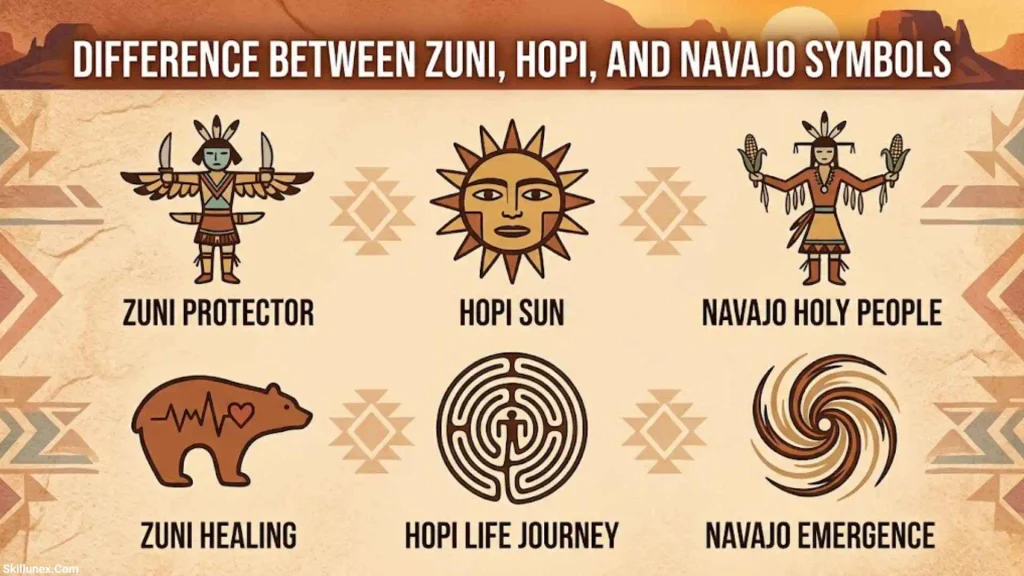
The Zuni, Hopi, and Navajo peoples have distinct histories and cultural traditions. Although their communities share a connection to the American Southwest and have interacted over time, their artistic practices and beliefs should not be treated as interchangeable.
Zuni Artistic Traditions
Zuni art is particularly associated with detailed stone inlay jewelry, animal carvings, pottery, and other forms of artistic expression. These traditions reflect the creativity and cultural heritage of Zuni artists.
Hopi Artistic Traditions
Hopi art includes pottery, basketry, textiles, carving, and other forms of craftsmanship. Hopi cultural traditions have their own histories, meanings, and ceremonial contexts.
Navajo Artistic Traditions
Navajo, or Diné, artistic traditions include silverwork, turquoise jewelry, weaving, and other crafts. Designs and meanings vary across objects, artists, and cultural settings.
Why the Differences Matter
A symbol or artistic motif associated with one community should not automatically be assigned to another. If you are researching a particular object, identify its cultural origin before interpreting its meaning.
This distinction helps you appreciate each community’s heritage accurately and respectfully.
How to Identify Authentic Zuni Art and Symbols
If you want to learn about Zuni art, start by identifying the artist and the object’s origin. This is especially important when purchasing jewelry, carvings, or pottery described as Native American or Southwestern.
Look for Artist Information
Information about the artist can help establish whether an object was made by a Zuni artist. Artist biographies, signed pieces, gallery descriptions, and reputable sellers may provide useful details.
Examine the Craftsmanship
Zuni jewelry and carvings can involve highly detailed workmanship. Examine the stone shapes, arrangement, finishing, and overall quality of the object.
However, craftsmanship alone cannot prove an object’s cultural origin or authenticity.
Ask About Materials and Techniques
Ask the seller or artist about the materials used, the production process, and whether the item was handmade. Clear answers can help you understand what you are buying.
Choose Reputable Sources
When possible, purchase directly from artists or from sellers who provide transparent information about the maker and the object’s origin.
Avoid assuming that every piece described as Southwestern, Native American-inspired, or Zuni-style was made by a Zuni artist.
How to Research Zuni Symbols Respectfully
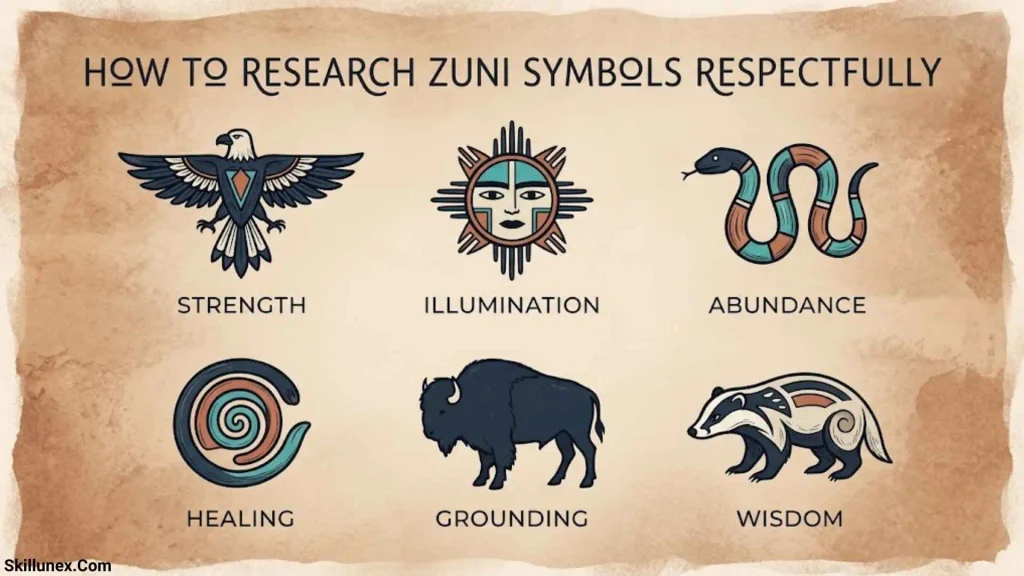
Researching Zuni symbols requires care because some cultural knowledge is specific to the community and may not be intended for public interpretation.
Use Reliable Cultural Sources
Look for educational materials from reputable museums, Indigenous cultural institutions, scholarly publications, and Zuni artists or community representatives.
These sources can help distinguish documented traditions from unsupported claims.
Ask the Artist About Their Work
If you are interested in contemporary artwork, the artist may be able to explain its materials, inspiration, and intended meaning.
Keep in mind that an artist’s personal explanation does not necessarily represent the beliefs of every Zuni person.
Avoid Universal Symbol Dictionaries
A simple online list may claim that every animal, color, or geometric shape has one fixed meaning. Such explanations can overlook cultural differences and individual artistic choices.
Instead, consider the source and context of each interpretation.
Respect Cultural Boundaries
Some designs and traditions have ceremonial or spiritual significance. Not all cultural knowledge is meant to be reproduced, interpreted, or used outside its intended context.
Approaching the subject with respect helps you learn without misrepresenting Zuni culture.
Frequently Asked Questions About Zuni Symbols and Meanings
What are Zuni symbols?
Zuni symbols include artistic motifs and visual representations associated with the history, art, and traditions of the Zuni people. They may appear in pottery, jewelry, animal carvings, and other objects.
What do Zuni animal symbols mean?
Animal imagery in Zuni art can reflect the natural environment, cultural stories, or particular traditional associations. The meaning of a specific animal depends on the artwork and its cultural context.
What are Zuni animal fetishes?
Zuni animal fetishes are carved objects, often made from stone, that are associated with Zuni artistic and cultural traditions. Some have traditional significance, while others are created as contemporary art or collectibles.
What does turquoise mean in Zuni culture?
Turquoise is an important material in Zuni jewelry and other Southwestern Indigenous artistic traditions. Its specific meaning varies according to the cultural context and the individual piece.
Do Zuni geometric patterns have specific meanings?
Some patterns may have cultural associations, while others serve primarily decorative purposes. A geometric shape should not be assigned a fixed meaning without reliable evidence.
Are Zuni symbols the same as Native American symbols?
No. Native American peoples have distinct cultures, languages, histories, and artistic traditions. Zuni symbols and designs should be understood within Zuni cultural contexts rather than treated as universal Indigenous symbols.
What is the difference between Zuni and Navajo jewelry?
Zuni jewelry is especially known for detailed stone inlay, needlepoint, and petit point techniques. Navajo jewelry is widely recognized for silverwork, turquoise settings, and other distinctive styles. Both traditions are diverse, and individual artists may use a range of techniques.
Where can I learn the true meanings of Zuni symbols?
Reliable sources include Zuni artists, appropriate cultural representatives, Indigenous cultural institutions, museums, and scholarly publications. The artist or cultural source is often the best place to begin when researching a particular design.
Conclusion
Zuni symbols and meanings provide an introduction to the artistic traditions, cultural heritage, and history of the Zuni people. From detailed animal carvings and turquoise jewelry to pottery and geometric patterns, Zuni art reflects both traditional knowledge and individual creativity.
When you explore these designs, remember that their meanings are not always universal or easy to summarize. I encourage you to look beyond the shape of a symbol and learn about its creator, cultural context, and purpose. By doing so, you can appreciate Zuni art more deeply while respecting the people and traditions behind it.

I’m Adrian Holloway, a writer and researcher who enjoys exploring the stories, meanings, and interesting facts behind the subjects people search for every day. I’m especially interested in symbols, nature, lakes, places, and cultural topics that help readers understand the world from a different perspective.
I believe useful content should be simple, accurate, and enjoyable to read. When I research a topic, I focus on finding meaningful details and presenting them in a way that makes information easy to understand.
My goal is to create helpful articles that answer real questions while encouraging readers to discover something new with every visit.
Books by Adrian Holloway
The Language of Symbols: Meanings, Stories & Traditions
Hidden Wonders of Nature: Lakes, Landscapes & Discovery