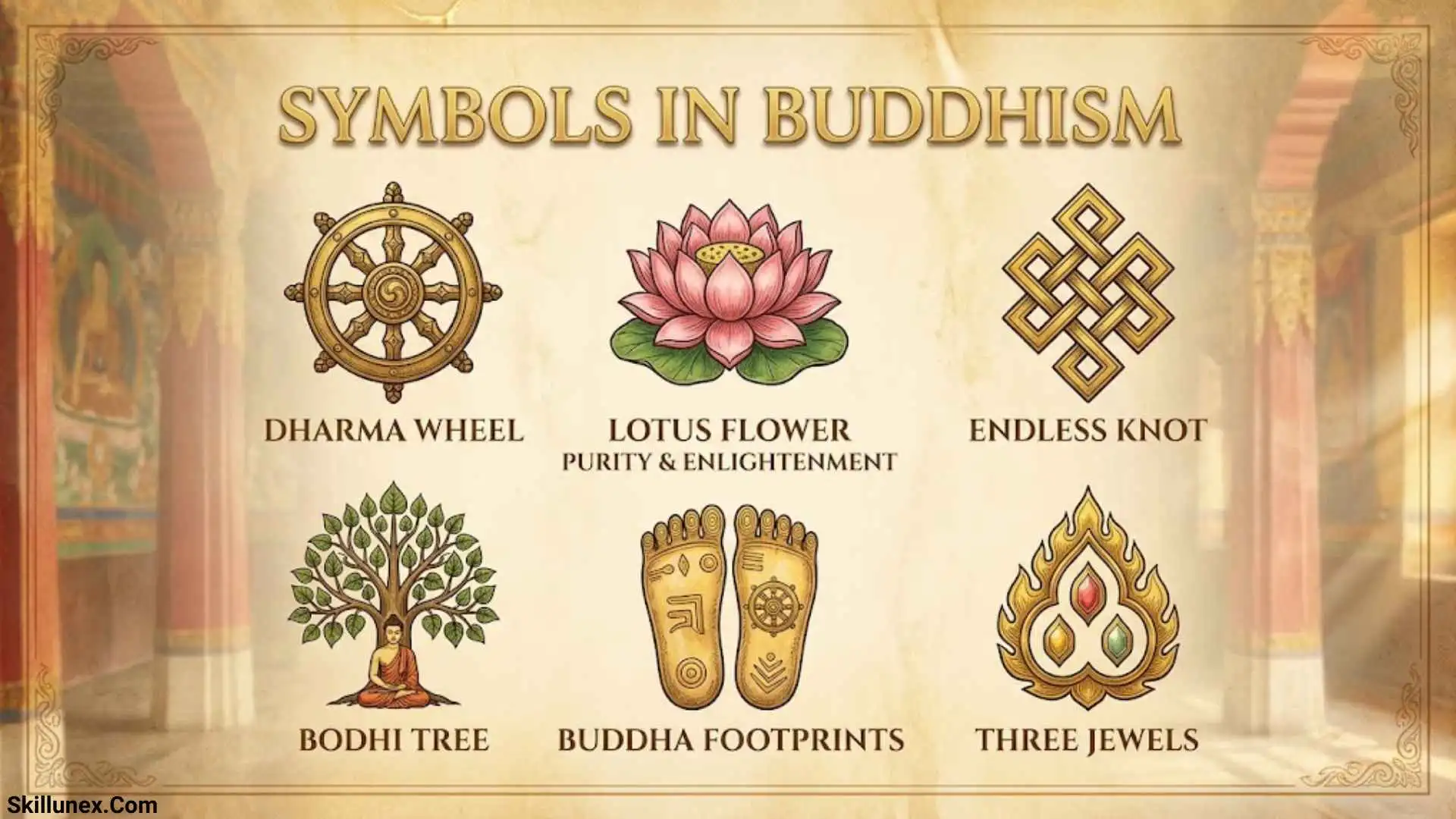
Symbols in Buddhism carry deep meanings that connect you with wisdom, peace, compassion, and enlightenment. From the sacred Lotus Flower to the Dharma Wheel, each symbol tells a story about life, suffering, and the journey toward spiritual awakening.
When you explore symbols in Buddhism, you discover how ancient images communicate powerful lessons about human nature, personal growth, and inner peace. These symbols have guided Buddhist communities for centuries and continue to inspire people around the world.
If you are learning about Buddhist traditions, exploring spiritual meanings, or searching for a symbol that reflects your beliefs, understanding these sacred signs helps you appreciate their history, cultural importance, and timeless wisdom.
Symbols in Buddhism: (Quick Answer)
Symbols in Buddhism represent important teachings about wisdom, peace, compassion, enlightenment, and the path to spiritual awakening. Common Buddhist symbols include the Lotus Flower, Dharma Wheel, Bodhi Tree, Endless Knot, and Golden Fish. Each symbol carries a unique meaning that helps you understand Buddhist beliefs, spiritual growth, and the journey toward inner peace.
Quick Facts About Symbols in Buddhism
| Aspect | Information |
| Origin | Ancient India, where Buddhism developed around the 5th century BCE |
| Historical Significance | Used to communicate Buddhist teachings through art, architecture, and rituals |
| Main Meaning | Wisdom, compassion, mindfulness, and liberation from suffering |
| Spiritual Meaning | Enlightenment, ethical living, and understanding reality |
| Cultural Importance | Important in Theravada, Mahayana, and Vajrayana Buddhism |
| Modern Usage | Found in meditation spaces, temples, jewelry, tattoos, and artwork |
What Are Symbols in Buddhism?
Symbols in Buddhism are visual signs, sacred objects, and artistic designs that communicate important Buddhist teachings. They represent ideas such as impermanence, karma, compassion, wisdom, and enlightenment.
These symbols help people understand spiritual concepts through familiar images. For example, a wheel represents the Buddha’s teachings, while a lotus flower illustrates how wisdom and compassion can develop despite life’s difficulties.
Origins of Buddhist Symbols
Buddhism began in ancient India through the teachings of Siddhartha Gautama, known as the Buddha. According to Buddhist tradition, he attained enlightenment and taught a path toward understanding suffering and its cessation.
Early Buddhist artists often represented the Buddha indirectly through symbols such as footprints, an empty throne, the Bodhi Tree, and the Dharma Wheel. These images allowed followers to remember the Buddha and his teachings without always depicting him in human form.
The Great Stupa at Sanchi in India preserves important examples of early Buddhist art and architecture. Its development began during the Mauryan period, traditionally associated with Emperor Ashoka in the 3rd century BCE.
How Buddhist Symbols Evolved Over Time
As Buddhism spread throughout Asia, its symbols developed different artistic styles and cultural meanings.
- Theravada Buddhism: Common in Sri Lanka and Southeast Asia, it frequently uses the Bodhi Tree, Buddha images, stupas, and Dharma Wheel.
- Mahayana Buddhism: Found in East Asian traditions, it includes lotus imagery and symbols associated with wisdom and compassion.
- Vajrayana Buddhism: Particularly prominent in Tibetan Buddhism, it uses the Vajra, Bell, Mandala, and Eight Auspicious Symbols.
Although their artistic forms differ, these traditions share many fundamental Buddhist teachings.
Why Buddhist Symbols Became Important
Buddhist symbols preserve religious teachings, support meditation, express devotion, and connect communities with their history.
When you see the Dharma Wheel, you can remember the Noble Eightfold Path. When you see the Lotus Flower, you can reflect on how personal growth is possible even during difficult times.
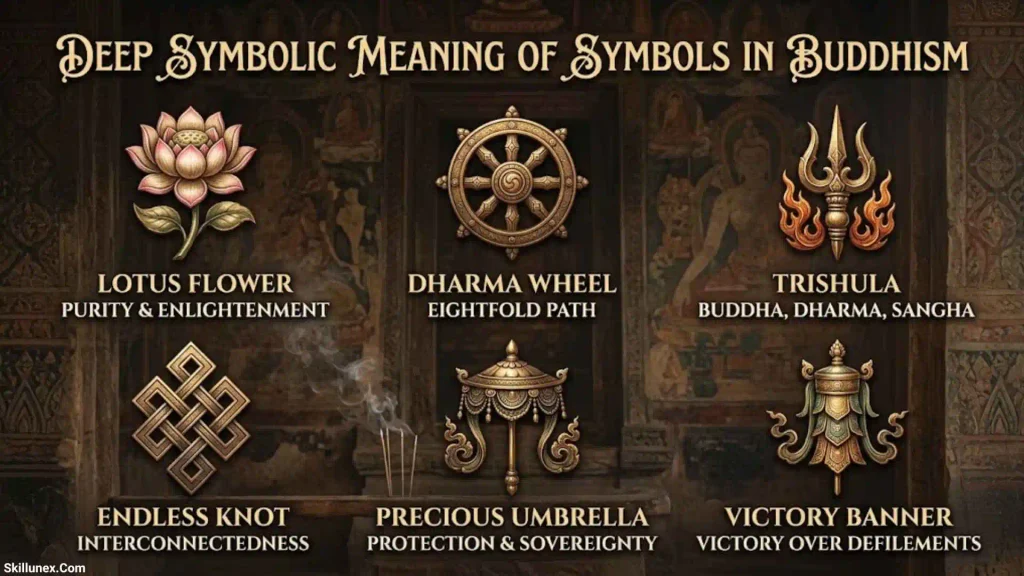
Deep Symbolic Meaning of Symbols in Buddhism
Spiritual Meaning
Buddhist symbols represent spiritual development and the path toward awakening.
The Dharma Wheel represents the Buddha’s teachings. The Bodhi Tree recalls the Buddha’s enlightenment, while the Lotus Flower symbolizes purity and spiritual growth.
These symbols encourage practitioners to develop wisdom, compassion, mindfulness, and freedom from attachment.
Psychological Meaning
Buddhist symbols can help people reflect on emotions, relationships, and personal challenges.
The Lotus Flower may remind you that difficult experiences do not have to define your future. The Endless Knot can encourage you to consider how your choices affect other people.
Psychologist Carl Jung explored mandalas as images connected with psychological wholeness. However, his interpretations differ from traditional Buddhist explanations, in which mandalas can have specific religious and ritual meanings.
Cultural Meaning
Buddhist symbols preserve cultural identity and religious traditions across generations.
In Sri Lanka, the Bodhi Tree is an important focus of devotion. In Tibetan Buddhism, the Eight Auspicious Symbols appear in paintings, textiles, ceremonial objects, and monastery decorations.
Understanding these symbols helps you appreciate both their spiritual meanings and their cultural importance.
Types and Variations of Symbols in Buddhism
Dharma Wheel
Visual Description: A circular wheel, often with eight spokes, a central hub, and an outer rim.
Meaning: The Dharma Wheel represents the Buddha’s teachings and the path toward enlightenment.
Symbolism: Its eight spokes commonly represent the Noble Eightfold Path: right view, intention, speech, action, livelihood, effort, mindfulness, and concentration.
Cultural Connection: It is widely recognized in Buddhist art and temple architecture.
Where It Appears: Temple entrances, paintings, sculptures, religious flags, and educational materials.
Lotus Flower
Visual Description: A lotus flower with layered petals, commonly shown in white, pink, or blue.
Meaning: The Lotus Flower represents purity, spiritual growth, and enlightenment.
Symbolism: The flower grows in muddy water but rises above the surface. This represents the possibility of developing wisdom and compassion despite life’s difficulties.
Cultural Connection: The lotus is important in Mahayana Buddhism and appears in representations of Buddhas and bodhisattvas.
Where It Appears: Temple paintings, statues, mandalas, jewelry, and meditation spaces.
Bodhi Tree
Visual Description: A sacred fig tree, scientifically known as Ficus religiosa, with distinctive heart-shaped leaves.
Meaning: The Bodhi Tree represents enlightenment and spiritual awakening.
Symbolism: Buddhist tradition holds that Siddhartha Gautama attained enlightenment while meditating beneath a tree at Bodh Gaya in present-day India.
Cultural Connection: The tree remains an important symbol of devotion, particularly in Sri Lanka and India.
Where It Appears: Temple gardens, pilgrimage sites, religious paintings, and Buddhist literature.
Endless Knot
Visual Description: An intricate geometric pattern that loops and crosses without a visible beginning or end.
Meaning: The Endless Knot represents interconnectedness, continuity, and the relationship between causes and consequences.
Symbolism: It reflects the Buddhist teaching that things arise through connected conditions rather than existing entirely independently.
Cultural Connection: It is one of the Eight Auspicious Symbols, especially prominent in Tibetan Buddhist traditions.
Where It Appears: Religious paintings, textiles, jewelry, temple decorations, and ceremonial objects.
White Conch Shell
Visual Description: A white conch shell, often featuring a right-turning spiral.
Meaning: The Conch Shell represents the far-reaching sound of the Buddha’s teachings.
Symbolism: Its powerful sound symbolizes the ability of the Dharma to reach people and encourage spiritual understanding.
Cultural Connection: The conch has a long history in South Asian religious traditions. In Tibetan Buddhism, it is one of the Eight Auspicious Symbols.
Where It Appears: Temple ceremonies, ritual instruments, paintings, and religious decorations.
Golden Fish
Visual Description: Two golden fish swimming together, often decorated with intricate patterns.
Meaning: The Golden Fish represent freedom, fearlessness, and well-being.
Symbolism: Their movement through water symbolizes freedom from the difficulties associated with samsara, the cycle of repeated existence.
Cultural Connection: The paired fish are part of the Eight Auspicious Symbols in Tibetan Buddhism.
Where It Appears: Temple murals, religious textiles, ceremonial objects, and decorative artwork.
Precious Parasol
Visual Description: An elaborate umbrella with a decorated canopy and hanging ornaments.
Meaning: The Precious Parasol represents protection, dignity, and refuge.
Symbolism: Its shade symbolizes protection from suffering and harmful influences.
Cultural Connection: The parasol has historical associations with royalty and honor in South Asia. It became one of the Eight Auspicious Symbols in Tibetan Buddhism.
Where It Appears: Temple paintings, ceremonial displays, statues, and religious textiles.
Treasure Vase
Visual Description: A decorated vase with a rounded body, narrow neck, and ornamental lid.
Meaning: The Treasure Vase represents abundance, prosperity, and spiritual wealth.
Symbolism: It symbolizes inexhaustible treasures, which may include wisdom, longevity, well-being, and the benefits of spiritual practice.
Cultural Connection: The vase is one of the Eight Auspicious Symbols in Tibetan Buddhism.
Where It Appears: Buddhist shrines, ritual objects, temple decorations, and religious paintings.
Victory Banner
Visual Description: An ornamental banner or cylindrical standard decorated with layers of fabric.
Meaning: The Victory Banner represents victory over obstacles and destructive mental states.
Symbolism: It symbolizes overcoming ignorance, attachment, hatred, and other barriers to spiritual awakening.
Cultural Connection: It is one of the Eight Auspicious Symbols and draws on older Indian traditions of ceremonial banners.
Where It Appears: Monastery roofs, temple artwork, religious paintings, and ceremonial objects.
Buddha’s Footprints
Visual Description: A pair of footprints, sometimes marked with Dharma Wheels or other auspicious signs.
Meaning: Buddha’s footprints represent his presence, teachings, and the path he left for others to follow.
Symbolism: They remind practitioners that spiritual understanding develops through practice and personal effort.
Cultural Connection: Buddha’s footprints were important in early Buddhist art, especially in South and Southeast Asia.
Where It Appears: Stone carvings, pilgrimage sites, temple floors, and ancient monuments.
Vajra or Dorje
Visual Description: A symmetrical ritual object with a central grip and pronged ends, usually made of metal.
Meaning: The Vajra represents indestructible wisdom, spiritual power, and clarity.
Symbolism: The Sanskrit word vajra is associated with both a thunderbolt and a diamond, suggesting strength and an enduring quality.
Cultural Connection: The Vajra has an important role in Vajrayana Buddhism, particularly in Tibetan Buddhist rituals.
Where It Appears: Ceremonial objects, religious paintings, monastery rituals, and mandala-related artwork.
Mandala
Visual Description: A geometric design arranged around a central point, often containing circles, squares, gates, and repeated patterns.
Meaning: A Buddhist Mandala represents sacred space and, in many traditions, an enlightened realm.
Symbolism: Mandalas can help practitioners visualize Buddhist teachings, focus attention, and explore aspects of Buddhist cosmology.
Cultural Connection: Mandalas are especially important in Vajrayana Buddhism, where their meanings depend on specific traditions and practices.
Where It Appears: Tibetan paintings, monastery walls, meditation practices, and sand mandala ceremonies.
The Eight Auspicious Symbols in Buddhism
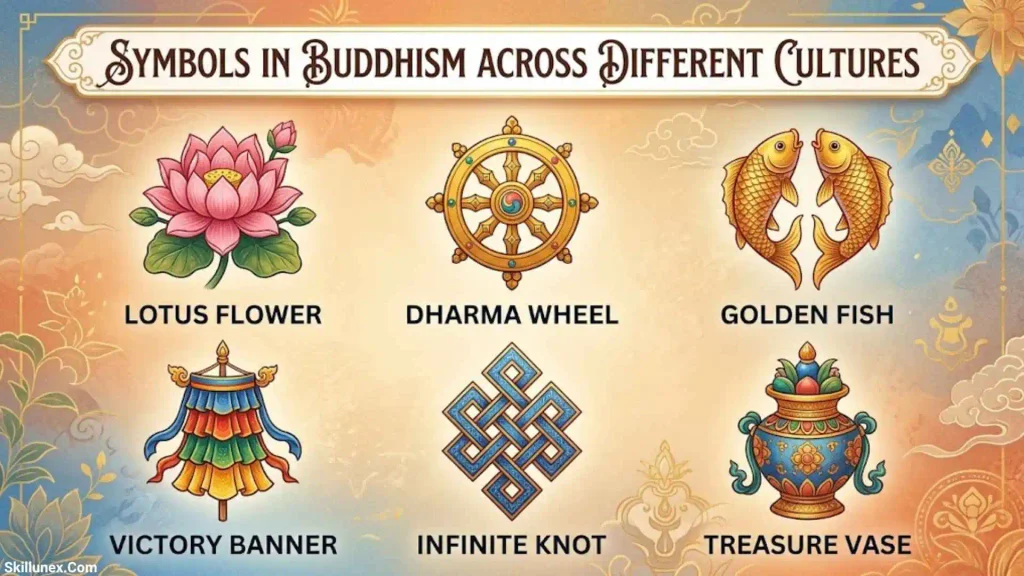
The Eight Auspicious Symbols, known in Sanskrit as Ashtamangala, form an important group in Tibetan Buddhism and related traditions.
| Symbol | Meaning |
| Dharma Wheel | The Buddha’s teachings and the path to enlightenment |
| White Conch Shell | The far-reaching sound of the Dharma |
| Lotus Flower | Purity and spiritual growth |
| Endless Knot | Interconnectedness and continuity |
| Golden Fish | Freedom and fearlessness |
| Precious Parasol | Protection and refuge |
| Treasure Vase | Abundance and spiritual wealth |
| Victory Banner | Overcoming obstacles and destructive mental states |
These symbols often appear together on temple walls, religious textiles, paintings, and ceremonial objects. Their interpretations may vary slightly between Buddhist traditions.
Symbols in Buddhism Across Different Cultures
Ancient Egypt
Ancient Egyptian culture used symbols such as the ankh, scarab beetle, and Eye of Horus to express ideas about life, protection, and religious belief.
The lotus also appeared in Egyptian art, where it could symbolize creation and renewal. Buddhist traditions developed their own associations with the lotus, especially purity and enlightenment.
Although the imagery sometimes looks similar, Egyptian and Buddhist symbols developed within different religious systems.
Ancient Greece
Ancient Greek culture used the olive branch and laurel wreath to represent peace, honor, and victory.
The Dharma Wheel is distinct from Greek religious symbolism, although wheels and circles also appeared in Greek art and philosophy.
Both cultures used visual forms to communicate ideas, but similarities in shape do not establish a shared religious origin.
Roman Culture
Roman culture used laurel wreaths, eagles, and other symbols to express victory, authority, and religious identity.
Buddhist art developed through cultural exchange across Asia. Gandhara, in present-day Pakistan and Afghanistan, became an important Buddhist artistic center influenced by several cultural traditions.
This historical exchange illustrates how artistic styles can interact while preserving distinct religious meanings.
Eastern Traditions
Asian Buddhist traditions developed many distinctive forms of religious symbolism.
- India: The Dharma Wheel, Bodhi Tree, lotus, and Buddha’s footprints have deep historical significance.
- Sri Lanka: The Bodhi Tree is central to Buddhist devotional traditions.
- China: Lotus flowers, Dharma Wheels, and auspicious emblems appear in Buddhist art and decoration.
- Japan: Buddhist temples and artworks use lotus imagery, mandalas, and symbols associated with different schools.
- Tibet: The Vajra, Bell, Mandala, and Eight Auspicious Symbols have important religious roles.
- Thailand: The Dharma Wheel, Buddha images, and sacred temple architecture are recognizable features of Buddhist visual culture.
Indigenous Traditions
Indigenous communities around the world have their own sacred symbols, stories, and relationships with the natural world.
Some designs may resemble Buddhist circles, knots, or animal imagery. However, visual similarity alone does not establish a shared meaning or historical connection.
Understanding each tradition within its own cultural context helps prevent inaccurate comparisons.
Modern Interpretations
Today, Buddhist symbols appear in art, fashion, meditation spaces, jewelry, and interior design.
A Lotus Flower may represent resilience, while a Mandala may be used as a decorative design. A Dharma Wheel may communicate Buddhist identity or an interest in Buddhist philosophy.
Modern interpretations can be meaningful, but they may not include the full religious significance of traditional symbols.
Similar Symbols and Their Meanings
| Symbol | Main Meaning | Key Difference |
| Dharma Wheel | Buddhist teachings | Represents the Dharma and the path of practice |
| Lotus Flower | Purity and spiritual growth | Emphasizes development despite difficulties |
| Bodhi Tree | Enlightenment | Connected to the Buddha’s awakening |
| Endless Knot | Interconnectedness | Highlights relationships between causes and conditions |
| Mandala | Sacred order | Often represents a sacred realm or contemplative practice |
| Vajra | Indestructible wisdom | Has specific ritual significance in Vajrayana Buddhism |
| Christian Cross | In Christianity, the crucifixion and resurrection of Jesus | Belongs to a different religious tradition |
| Egyptian Ankh | Life and vitality | Originates in ancient Egyptian religious symbolism |
| Yin-Yang | Complementary forces | Belongs to Chinese philosophical traditions and is not exclusively Buddhist |
Buddhist Symbols vs. General Spiritual Symbols
General spiritual symbols may have personal meanings, while Buddhist symbols are connected with particular teachings, histories, or religious practices.
For example, a circle may represent unity in a personal design. A traditional Buddhist Mandala can represent a specific sacred realm and involve structured visualization or ritual practices.
The Lotus Flower also appears in several religious traditions, but its meaning depends on the cultural and historical context.
Is the Buddhist Swastika the Same as the Nazi Symbol?
The swastika is an ancient symbol used in several Asian religious traditions, including Buddhism, Hinduism, and Jainism. In Buddhist contexts, it has been associated with auspiciousness and well-being.
The Nazi regime appropriated a version of the swastika as an emblem of racist and antisemitic ideology. This history means the symbol can cause serious distress, particularly in Western societies.
The historical and religious contexts are different, but the harm associated with Nazi imagery should not be dismissed. When interpreting a swastika, consider its location, design, and cultural setting.
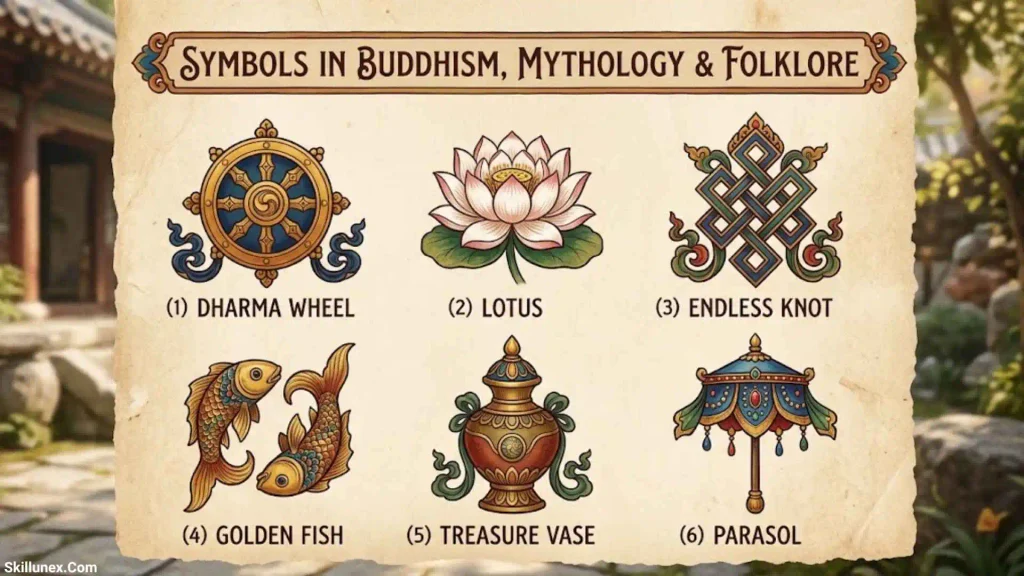
Symbols in Buddhism in Mythology and Folklore
The Bodhi Tree and Enlightenment
According to Buddhist tradition, Siddhartha Gautama attained enlightenment while meditating beneath a Bodhi Tree.
The story emphasizes insight, sustained attention, and freedom from ignorance. The tree became a lasting symbol of awakening because it connects a profound spiritual event with the natural world.
The Lotus and Spiritual Growth
The Lotus Flower appears throughout Buddhist literature and art. Its growth from muddy water offers a powerful image of purity and spiritual development.
The Lotus Sutra is also an important scripture in Mahayana Buddhism, although its teachings are more extensive than the general symbolism of the flower.
The Dharma Wheel and the First Sermon
Buddhist tradition describes the Buddha’s first sermon at the Deer Park in Sarnath, India.
The sermon introduced teachings associated with the Four Noble Truths and the path toward the cessation of suffering. The Dharma Wheel became a symbol of the Buddha’s teachings and their continuing transmission.
Mandalas and Sacred Realms
In Vajrayana Buddhism, Mandalas can represent the sacred environment of a Buddha or an enlightened figure.
They may be used in visualization, initiation, and structured religious practices. Their meanings depend on specific traditions and teachings rather than on decoration alone.
Symbols in Buddhism in Art, Literature, Movies, and Pop Culture
Buddhist Symbols in Paintings and Sculpture
Buddhist paintings and sculptures use symbols to communicate religious ideas and identify sacred figures.
A lotus throne may represent purity and awakening. A Dharma Wheel may refer to the Buddha’s teachings, while specific hand gestures, known as mudras, can represent teaching, meditation, generosity, or reassurance.
Buddhist Symbols in Literature and Poetry
Writers may use the Lotus Flower to explore resilience or the Dharma Wheel to represent change and direction.
These literary interpretations can draw inspiration from Buddhist teachings while expressing the writer’s own ideas.
Buddhist Symbols in Movies and Television
Films and television sometimes use Buddhist imagery to suggest meditation, spiritual discovery, or a search for peace.
However, a character’s interpretation may differ from traditional Buddhist teachings. Popular storytelling often simplifies religious symbols to communicate an idea quickly.
Buddhist Symbols in Tattoos
People choose Buddhist symbols for tattoos to express personal growth, mindfulness, cultural identity, or admiration for Buddhist philosophy.
Common designs include the Lotus Flower, Dharma Wheel, and Endless Knot. Learning about their religious meanings before choosing a tattoo helps you make an informed and respectful decision.
Buddhist Symbols in Fashion and Design
Lotus patterns, Endless Knots, and Mandala-inspired designs appear on clothing, accessories, stationery, and home decorations.
Their popularity reflects an interest in symmetry, detailed patterns, and spiritual themes. However, decorative use may not communicate the full meaning these symbols hold for Buddhist practitioners.
Spiritual and Dream Meaning of Symbols in Buddhism
Seeing a Lotus Flower in a Dream
A lotus may remind you of renewal, patience, and personal growth. If you associate it with Buddhist teachings, you might reflect on how you respond to difficult circumstances.
However, Buddhism does not offer one universal dream dictionary in which every lotus has a fixed meaning.
Seeing a Dharma Wheel in a Dream
A Dharma Wheel may encourage you to reflect on your choices, responsibilities, and personal direction.
You might consider whether your daily actions reflect your values and whether you treat others with wisdom and compassion.
Seeing a Bodhi Tree in a Dream
A tree may bring to mind stability, growth, and quiet reflection.
If you associate the image with the Bodhi Tree, it can become an opportunity to consider what understanding or change means in your life.
Buddhist Symbols During Meditation
Some meditation practices deliberately use visual symbols, while others emphasize observing thoughts and sensations without attachment.
If an image appears during meditation, you do not need to treat it as a supernatural message. You can simply notice the experience and return your attention to the practice.
Positive and Negative Meanings of Symbols in Buddhism
| Positive Meaning | Cautionary Meaning |
| Lotus Flower: Purity and growth | Growth requires patience and effort |
| Dharma Wheel: Guidance and wisdom | Understanding requires practice |
| Endless Knot: Connection and continuity | Actions can create repeating patterns |
| Bodhi Tree: Awakening and insight | Wisdom develops through sustained effort |
| Golden Fish: Freedom and fearlessness | Encourages reflection on fear and attachment |
| Victory Banner: Overcoming obstacles | Requires confronting harmful habits |
| Treasure Vase: Abundance and well-being | Encourages reflection on material attachment |
| Mandala: Harmony and sacred order | Maintaining focus can be challenging |
| Vajra: Strength and clarity | Power requires wisdom and responsibility |
| Precious Parasol: Protection and refuge | Support does not remove every difficulty |
Can Buddhist Symbols Have Negative Meanings?
Traditional Buddhist interpretations generally emphasize positive spiritual qualities or lessons about suffering. Negative meanings are often personal or context-dependent rather than fixed parts of Buddhist doctrine.
For example, the Endless Knot can represent interconnectedness while also encouraging you to examine how repeated habits influence your life.
Understanding a symbol’s traditional meaning first helps you distinguish established teachings from personal interpretations.
Why Humans Are Attracted to Symbols in Buddhism
Humans Naturally Recognize Patterns
People notice circles, repeated shapes, and symmetry. These patterns can make symbols easier to recognize and remember.
A mandala, for example, often uses a central point and balanced geometric forms. Its religious significance, however, goes beyond its visual appearance.
Symbols Give Emotions a Visual Form
A Lotus Flower may help you express the experience of growing through difficult circumstances. Someone else may connect with the Bodhi Tree because it represents stillness and insight.
Symbols can give people a way to express emotions and experiences that are difficult to put into words.
Cultural Memory Makes Symbols Powerful
When symbols appear in temples, family traditions, ceremonies, and religious stories across generations, they become connected with shared history.
For Buddhist communities, the Dharma Wheel can represent the continuing transmission of the Buddha’s teachings.
Symbols Encourage Mindfulness
A familiar symbol can remind you to pause before reacting to a difficult situation.
The Lotus Flower may encourage patience, while the Dharma Wheel may prompt you to consider whether your actions reflect your values. The benefit comes from reflection and practice rather than assuming the image has automatic power.
Modern Uses of Symbols in Buddhism
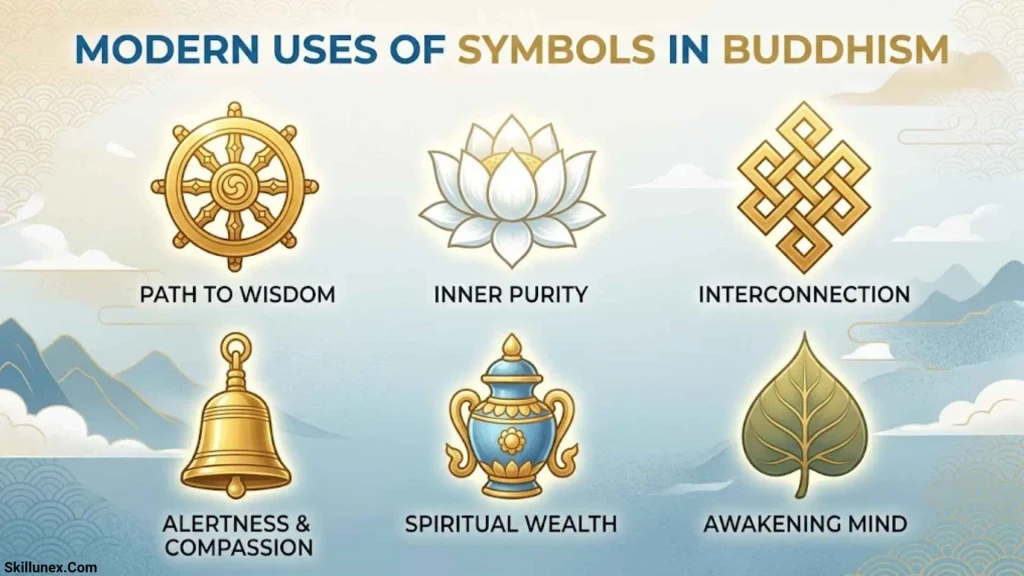
Tattoos and Personal Expression
The Lotus Flower, Endless Knot, and Dharma Wheel are popular designs for people interested in Buddhist philosophy or mindfulness.
Researching a design’s original meaning helps you understand its cultural significance before using it.
Jewelry and Accessories
Pendants, bracelets, and necklaces may feature lotus designs, Dharma Wheels, or Endless Knots.
For practicing Buddhists, these objects can express devotion. Others may wear them because they appreciate the artwork or its symbolic message.
Home Decor and Meditation Spaces
Buddhist-inspired decorations include Mandalas, lotus artwork, Buddha images, and the Eight Auspicious Symbols.
These objects can create a space for reflection, but decorations alone do not replace meditation or spiritual practice.
Branding and Graphic Design
Designers sometimes use lotus shapes, circular forms, or Endless Knot patterns to suggest balance, wellness, and interconnectedness.
Accurate descriptions and respectful use are important when Buddhist imagery appears in commercial designs.
Social Media and Contemporary Spirituality
Buddhist symbols appear in inspirational posts, meditation videos, and digital illustrations.
Although these images can introduce people to Buddhist teachings, brief captions may leave out important historical or religious details.
Interesting Facts About Symbols in Buddhism
- The Dharma Wheel has eight spokes. They are commonly associated with the Noble Eightfold Path.
- The Bodhi Tree is a sacred fig. Its scientific name is Ficus religiosa.
- Early Buddhist art sometimes represented the Buddha indirectly. Footprints, empty thrones, and Bodhi Trees could evoke his presence.
- The Eight Auspicious Symbols form a traditional group. They are particularly important in Tibetan Buddhism.
- Buddhist symbols appear on historical objects. Textiles, paintings, porcelain, and ritual implements preserve many examples.
- Mandalas have specific religious uses. In Vajrayana Buddhism, they can be connected with visualization, ritual, and sacred cosmology.
- The Vajra has associations with diamonds and thunderbolts. These images help explain its symbolism of indestructible wisdom and spiritual power.
- Similar symbols can have different meanings. A lotus or wheel may appear in several cultures without having the same religious significance.
Frequently Asked Questions
What Is the Main Symbol of Buddhism?
The Dharma Wheel is one of the most widely recognized symbols of Buddhism. It represents the Buddha’s teachings, and its eight spokes are commonly associated with the Noble Eightfold Path.
What Are the Eight Symbols in Buddhism?
The Eight Auspicious Symbols are the Dharma Wheel, White Conch Shell, Lotus Flower, Endless Knot, Golden Fish, Precious Parasol, Treasure Vase, and Victory Banner.
What Does the Lotus Flower Mean in Buddhism?
The Lotus Flower represents purity, spiritual growth, and the possibility of enlightenment. It illustrates how wisdom and compassion can develop despite life’s difficulties.
What Does the Dharma Wheel Symbolize?
The Dharma Wheel represents the Buddha’s teachings. Its eight spokes are associated with the Noble Eightfold Path, which guides ethical conduct, mental discipline, and wisdom.
What Does the Endless Knot Mean in Buddhism?
The Endless Knot symbolizes interconnectedness, continuity, and the relationship between causes and conditions. It encourages reflection on how actions and circumstances influence one another.
Can You Wear Buddhist Symbols as Jewelry?
Yes, people wear Buddhist symbols for religious devotion, cultural expression, or personal reflection. Learning about a symbol’s history and cultural significance helps you use it respectfully.
Conclusion
Symbols in Buddhism offer a meaningful way to understand Buddhist teachings about wisdom, compassion, peace, and enlightenment. From the Lotus Flower and Dharma Wheel to the Bodhi Tree and Endless Knot, each symbol shares an important lesson about life, spiritual growth, and overcoming suffering. When you explore these symbols, you discover how ancient traditions continue to inspire people to live with greater awareness and kindness.
I believe learning about Buddhist symbols helps you appreciate the deeper meanings behind Buddhist culture and spiritual practices. If you are studying Buddhism or simply exploring its sacred signs, these symbols can encourage you to reflect on your own life, develop inner peace, and practice compassion toward others. By understanding their meanings and history, you can gain a clearer picture of the wisdom that makes Buddhist symbols meaningful across generations.

I’m Adrian Holloway, a writer and researcher who enjoys exploring the stories, meanings, and interesting facts behind the subjects people search for every day. I’m especially interested in symbols, nature, lakes, places, and cultural topics that help readers understand the world from a different perspective.
I believe useful content should be simple, accurate, and enjoyable to read. When I research a topic, I focus on finding meaningful details and presenting them in a way that makes information easy to understand.
My goal is to create helpful articles that answer real questions while encouraging readers to discover something new with every visit.
Books by Adrian Holloway
The Language of Symbols: Meanings, Stories & Traditions
Hidden Wonders of Nature: Lakes, Landscapes & Discovery